Quiet skies, loud arithmetic: a day of Israeli strikes across south Lebanon
A burst of Israeli air and artillery activity hit Nabatieh, Kafr Tibnit, Qabrikha and a vehicle near Al-Musaylih within roughly ninety minutes. Monexus reads the pattern before the press notices it.
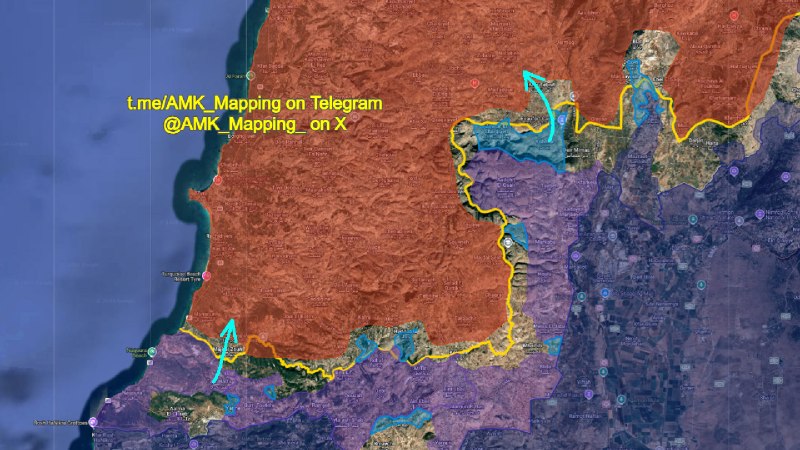
Between 20:18 and 21:54 UTC on 13 June 2026, the south Lebanese skyline took the better part of an hour's worth of punishment. Al-Alam Arabic's breaking ticker, mirrored across Telegram, logged an opening raid on Nabatieh al-Fawqa and Kafr Benit, then artillery on the city of Nabatieh itself, a strike on a car in the Al-Musaylih area south of the Litani, an air raid on Nabatieh al-Fawqa and Qabrikha, and finally an air raid on Kafr Tibnit. Five discrete events in ninety-six minutes, all of them south of the Litani, all of them falling inside the same narrow arc of south Lebanese geography that has carried the weight of every round of this war. The pattern is the story.
What the wires have not yet caught up to is the cadence. Israeli and Hezbollah-linked exchanges since the November 2024 ceasefire have been reported in clusters — a strike here, a retaliatory rocket there — but rarely at this density inside a single evening. South Lebanon is being treated, in operational terms, as a continuation of the Gaza theatre rather than a separate file. The arithmetic of that choice belongs to Israeli planners. The diplomatic cost belongs to everyone else.
What the evening actually looked like
Strip the breaking-news caps and the geography is striking. Four of the five reported events sit inside the Nabatieh governorate: the city of Nabatieh itself, the upper town of Nabatieh al-Fawqa, the village of Qabrikha, and Kafr Tibnit. Kafr Benit, hit in the opening salvo at 20:18 UTC, is the same village that has appeared in Israeli strike reporting in past escalations. The fifth event, a car targeted in Al-Musaylih south of Lebanon, is consistent with a targeted-killing profile rather than a fixed-site strike. Taken together, the five reports describe a layered evening: area bombardment, a vehicle strike, and follow-on raids — the standard sequence when Israeli airpower is asked to hit both infrastructure and a specific person.
Al-Alam Arabic, the Lebanese Hezbollah-aligned channel broadcasting the ticker, is not a neutral wire. Its framing favours Hezbollah's own communiqués, and its casualty figures, when they appear, tend to lag and overcount. But its geolocation is reliable: Nabatieh, Kafr Tibnit, Qabrikha and Al-Musaylih are real towns in the Bint Jbeil and Nabatieh districts, and the sequence of times published is internally consistent. The Israeli military has not, as of this writing, issued a public summary of the evening's operations; the Lebanese health ministry has not yet posted aggregate casualty figures. The ground truth between the two communiqués is, for now, the silence of the Lebanese Civil Defense press line.
Why south Lebanon, again
The geography of these strikes is not accidental. The Litani river — running east from Tyre to the Syrian border — has been the de facto line of Israeli operational concern since 1978. Villages south of the Litani have, in turn, become the named list of places that appear in Israeli strike reporting whenever the security cabinet wants to signal that Hezbollah is being held to a perimeter. Nabatieh, the governorate capital, sits a few kilometres north of the river and has functioned as a Hezbollah administrative and logistical centre for decades. Qabrikha and Kafr Tibnit sit deeper inside what Israeli intelligence maps as the rocket-launch belt. A car strike in Al-Musaylih, on the road between Tyre and the border, is consistent with a hunt for a specific operative transiting the coast.
The honest reading is that this is not escalation in the colloquial sense — there is no single new decision being announced. It is maintenance. The November 2024 ceasefire arrangement holds, in the formal sense that no Israeli ground operation has been launched and no large-scale Hezbollah rocket barrage has materialised in response. But the side-terms of that arrangement, the air-strike-on-Hezbollah-assets-per-week norm, have been quietly thickened, and the threshold for what counts as an asset has dropped.
The framing contest
Two stories are being written about this evening in real time. The first, which will run on Israeli evening news, will frame the strikes as a continuation of the post-ceasefire security doctrine: precision action against Hezbollah reconstitution, with civilian harm minimised because the targets are vehicles, rural villages or operational infrastructure. The second, which will run on Al-Mayadeen and Al-Alam, will frame the same evening as bombardment of a densely populated governorate and an Israeli government choosing escalation over the diplomatic process it claims to support.
Both framings are doing work, and neither is wrong on its own terms. The clean editorial test is whether each can be stated in its strongest form, then weighed. The Israeli security concern — that Hezbollah re-arms faster than sanctions and quiet deterrence can contain it — is legitimate, and the south Lebanese geography is a fair place to ask the question. The Lebanese civilian concern — that "precision" is a relative term when five events in ninety-six minutes land in towns of a few thousand people each — is also legitimate, and it does not require a Hezbollah-aligned source to be believed. The honest reading is that both can be true at once, and on a day like today, both are.
What we do not yet know
Three things remain unclear as this article goes out. First, the casualty count: the Lebanese health ministry has not posted a consolidated figure, and the Israeli military has not released a target list. Second, the target of the Al-Musaylih car strike: vehicle strikes of this profile are usually named-officer operations, but no communique from either side has been issued. Third, the response: the operative question after an evening like this is whether Hezbollah's rocket or drone units fire back inside the next 24 hours, and there is no public signal yet. The November 2024 arrangement has held through thicker evenings than this. The risk is not that one evening breaks it; the risk is that each evening slightly normalises a higher baseline, until the baseline itself becomes the new doctrine.
Desk note: Wire reporting on Israeli operations in south Lebanon is consistently faster on the Lebanese side and more cautious on the Israeli side. Monexus reads both, treats casualty figures as preliminary until the Lebanese health ministry publishes, and notes the pattern across events rather than treating each strike in isolation.
Wire provenance
This editorial synthesis draws on the following public wire/social posts:
- https://t.me/s/alalamarabic/
- https://t.me/s/alalamarabic/
- https://t.me/s/alalamarabic/
- https://t.me/s/alalamarabic/
- https://t.me/s/alalamarabic/