Qatar's stoppage-time equaliser against Switzerland opens the 2026 World Cup with a geopolitical subplot
A 1-1 draw in Group B was a forgettable result for most football fans, but it doubled as a soft-power milestone for the tournament's most contested host.
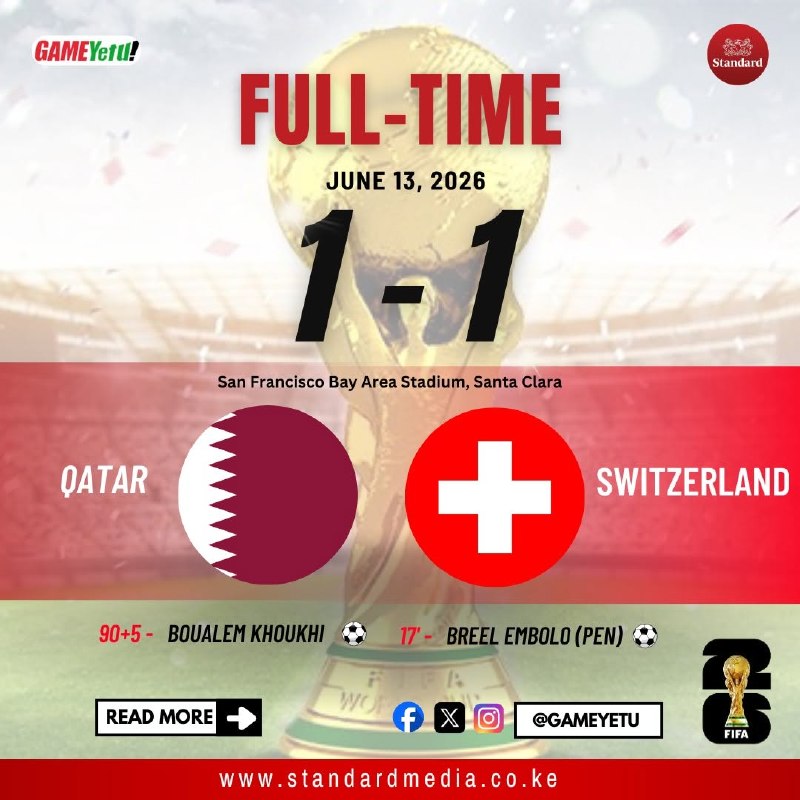
Qatar's national football team left the field at full time on Saturday evening with a result that, on paper, looks modest: a 1-1 draw with Switzerland in the opening Group B fixture of the 2026 World Cup. The manner of the point, however, carried weight well beyond the standings. Boualem Khoukhi's equaliser deep into stoppage time — confirmed by teleSUR English at 21:01 UTC and corroborated within minutes by Geo Politics Watch and France 24's English wire — gave the tournament's most politically fraught host a debut moment it will be allowed to remember.
The goal, coming after Switzerland had controlled long stretches of the second half in search of a winner, is the kind of storyline FIFA can edit into a marketing reel. It is also the kind of storyline that, two years ago, would have drawn little scrutiny. In 2026, when every match the Qatari team plays is read through the lens of the federation's labour, governance and geopolitical record, even a single point travels with subtext.
A draw that doubles as a diplomatic frame
Switzerland took the lead through Breel Embolo, the forward born in Yaoundé and raised in Geneva whose international career has long carried its own geopolitical freight. France 24's English wire logged the match as ending with a "dramatic draw" in which Switzerland was "caught off guard" by a late equaliser; teleSUR English framed the contest as "a tale of two halves" in which Embolo's early strike was cancelled by Khoukhi's intervention after Switzerland had "spent much of the second half pushing for a second." CubaDebate, summarising the same fixture, called it "Qatar's first historic point" in a World Cup finals.
The geography of the 2026 tournament matters to the read. This is the first World Cup staged across three host nations — the United States, Canada and Mexico — and the first in which Qatar's national side has appeared in the wider North American production. Qatar is, of course, the host of the previous edition, the 2022 tournament whose run-up and delivery were defined by migrant-worker deaths, the abrupt diplomatic rupture with several Gulf neighbours, and the federation's subsequent push to rebrand the Gulf as a football power. That rebrand, bankrolled by the Qatar Investment Authority's parallel purchases of Paris Saint-Germain and a stake in the Washington Capitals, has had uneven results on the pitch. The Switzerland draw is the first competitive data point of the new cycle.
The counter-narrative: a fair result on the night
Stripped of the framing, the match produced a result most analysts would have predicted. Switzerland, ranked comfortably above Qatar in FIFA's published standings and fielding the more experienced European-based core, dominated possession and territory. The Swiss pushed for a second goal for most of the second half, according to teleSUR's running account, and were undone by a single lapse in the closing minutes — the kind of late concession that visits World Cup debutants more often than the established order likes to admit.
The counter-read, then, is that this is a story about football, not foreign policy. Khoukhi, a veteran of Al Sadd and a long-time senior figure in the Qatari squad, has scored in major tournaments before, including the 2019 Asian Cup. The point is a fair reward for a side that absorbed pressure and converted one of its limited opportunities. There is no scandal in a stoppage-time equaliser at a World Cup; the format all but invites them.
The reason the framing will not stay domestic, however, is that Qatar has spent the post-2022 period insisting on exactly this kind of stage. Doha's sports strategy, in the words of officials who have briefed European outlets repeatedly since 2022, treats every match the national side plays as a piece of reputational infrastructure. A late draw against a European heavyweight in the opening fixture of the next cycle, broadcast across a North American production that will reach record audiences, is the precise product that strategy is designed to manufacture.
What the result sits inside
The pattern is not new. Gulf state money has reshaped European football's ownership map; the 2022 World Cup itself was, in retrospect, a six-week argument about whether a tournament's geopolitical cost could be amortised by its sporting spectacle. The cycle since has been the amortisation phase. Saudi Arabia's hosting of the 2034 World Cup, confirmed by FIFA in late 2024, will push the same questions into a sharper key. The 2026 edition — contested across three North American capitals with a 48-team field — is the bridge between those two Gulf moments.
Inside that bridge, a 1-1 draw is small change. But small change compounds. Qatar's point against Switzerland is its first ever in a World Cup finals; for a federation that had previously qualified only once and lost all three of its 2022 group matches, the ledger has finally been opened in positive numbers. The diplomatic signal — to Doha's critics, to its rivals in Abu Dhabi and Riyadh, and to FIFA's commercial partners — is that the project remains on track.
Stakes for the rest of the group
For Switzerland, the cost is the loss of two points the side will almost certainly need. Group B of the 2026 World Cup also includes the winner of an intercontinental play-off path that had not, at the time of the sources reviewed, been fully resolved. Embolo's opener will be remembered, but tournament football is decided by what follows, and Switzerland now faces the prospect of treating the remaining group fixtures as near must-wins.
For Qatar, the path is narrower. Khoukhi's goal buys belief and breathing room, but the side will still need at least one win — and almost certainly goal difference — to be in the conversation for the round of 16. The diplomatic value of the draw, however, is already booked. The football question is open. The framing question, in Doha's favour or against it, will follow the team to its next fixture.
This publication framed the draw as a geopolitical milestone first and a sporting result second, in contrast with European wires that led on the sporting upset. The teleSUR English wire, by contrast, treated the result as an act of regional representation — a reading that aligns with how Doha's state-aligned outlets will likely package the result in the days ahead.
Wire provenance
This editorial synthesis draws on the following public wire/social posts:
- https://t.me/CubaDebate/
- https://t.me/france24_en/
- https://t.me/GeoPWatch/