Southern Lebanon by air and by shell: the geometry of an undeclared war
Five Israeli strikes on southern Lebanon in roughly ninety minutes reveal a campaign that is daily, methodical, and almost entirely outside the wire-cycle attention it deserves.
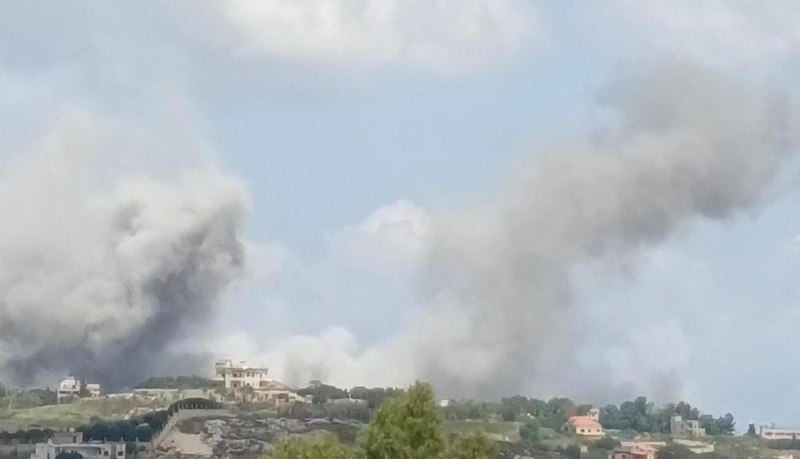
Between 20:18 and 21:35 UTC on 13 June 2026, the Beirut-aligned channel Al-Alam Arabic filed five urgent dispatches from a single, narrow strip of geography: southern Lebanon. The raids, named in order, were on Nabatieh Al-Fawqa and Kafr Benit; on Mifdoun; on the city of Nabatieh itself, by artillery; on a car in Al-Musaylih; and again on Nabatieh Al-Fawqa, this time together with Qabrikha. Five strikes, all attributed to the Israeli air force, inside an hour and seventeen minutes.
That cadence is the story. The war between Israel and Hezbollah in southern Lebanon is no longer a story of escalation days bracketed by quiet weeks. It is a metronome.
What the wire is not covering, and what the dispatches show
Western wire reporting on the Israel–Lebanon front has, for most of 2026, organised itself around two anchors: the ceasefire framework negotiated in late 2025, and the periodic, named-episode exchanges — a senior commander killed, a village council struck, a UNIFIL posture statement. Both of those frames are real. Neither captures the rhythm visible in the Arabic-language wire on Saturday evening: a town struck by jet, shelled by tube artillery within twenty minutes, struck again by jet before the next town down the road is hit.
The places recur. Nabatieh — both the city and the upper town — appears in three of the five dispatches. Qabrikha, Mifdoun, Kafr Benit and Al-Musaylih cluster inside a radius of roughly fifteen kilometres. This is not the geography of a hunt for mobile launchers, a phrase that gets used in Israeli briefings and recycled in the English-language wire. It is the geography of a populated district being treated, hour by hour, as a battlespace.
The information asymmetry, and why it matters
The reason an editor sitting in London or Washington can read the five Al-Alam items and still feel under-informed is structural, not conspiratorial. The Arabic-language regional press and the Lebanese domestic outlets are filing in real time from a place where the international press corps is thin, restricted and largely dependent on Israeli, UNIFIL or Lebanese army statements for confirmation. The Al-Alam items, which originated as a Hezbollah-aligned channel and should be read as such, still function as a near-real-time sensor of what is physically happening on the ground in villages the wire services dispatch to once a month.
Israeli military spokespeople have, in the past, distinguished between strikes on Hezbollah infrastructure and strikes on what the IDF frames as civilian objects used for military purposes. The five items above do not specify targets, munitions or claimed justification; neither do they specify casualty figures. They are scene reports, not battle damage assessments. But the frequency and co-location of the strikes is itself a piece of evidence that the wire's episode-based framing quietly omits.
The structural frame: a low-visibility, high-frequency campaign
What is unfolding in Nabatieh governorate fits a pattern this publication has watched since the November 2024 ceasefire: an Israeli air campaign that, by the standards of any other theatre, would dominate the front pages, but that, because it is framed as "post-war deterrence," has been allowed to settle into the background noise of regional coverage. The strikes are daily. They are distributed across multiple towns rather than concentrated on a single high-value target. They mix fixed-wing and tube artillery, which is unusual for a campaign supposedly aimed at precision targets, and they treat the southern suburbs of Nabatieh city as a permanent operating area.
The plain-language read: this is the air war the international press decided, collectively, not to count as a war.
Stakes
For Israel, the calculus is intelligible and openly stated: degrade Hezbollah's reconstitution in the border districts, prevent the kind of October-2023-style cross-border posture from rebuilding, and accept the political cost of a slow-drip civilian toll in Lebanese Shia towns. The cost of that strategy is borne in Nabatieh governorate, in the cars, the houses, the agricultural land and the people who live there, and is recorded — when it is recorded at all — in the urgent ticker of an Arabic-language channel.
For Lebanon, the cost is that the country's south is being administered, in practice, by a foreign air force with no functioning Lebanese-state countervailing capacity and no functioning international ceasefire enforcement.
For the international audience, the cost is a slower one: a steady habituation to strikes that, if they were happening in any theatre the wire had decided to follow, would not be tolerable as a fact of life.
What remains uncertain
Casualty figures for the five strikes on 13 June are not in the source material. The IDF had not, as of the time of the last Al-Alam item at 21:35 UTC, issued a statement naming the targets or the claimed justification. UNIFIL had not, in the items reviewed, commented. The Lebanese army's posture in Nabatieh governorate on the day in question is not specified. These gaps are themselves a piece of the story: in a conflict the international system has effectively outsourced to a single side's air force, the verification layer that normally accompanies a sustained bombing campaign is missing.
The honest version of this story is that the picture above is built on five urgent tickers from one channel, plus the structural pattern visible to any reader who follows the regional press. It is not the last word on 13 June 2026 in southern Lebanon. It is, however, more than the English-language wire offered in the same hour.
— Monexus frames this as a pattern story built on Arabic-language scene reports that the Western wire has not, on this day, chosen to follow in real time. The structural claim — that southern Lebanon is undergoing a sustained, low-visibility air campaign — is supported by frequency and co-location of strikes, not by a single attributed casualty toll.
Wire provenance
This editorial synthesis draws on the following public wire/social posts:
- https://t.me/s/alalamarabic
- https://en.wikipedia.org/wiki/Nabatieh_Governorate
- https://en.wikipedia.org/wiki/United_Nations_Interim_Force_in_Lebanon