A 1-1 Draw in East Rutherford, and the Story FIFA Doesn't Want You to Read
Brazil and Morocco played out a 1-1 draw at MetLife Stadium on 13 June 2026 — and the fixture itself is the story FIFA would rather you missed.
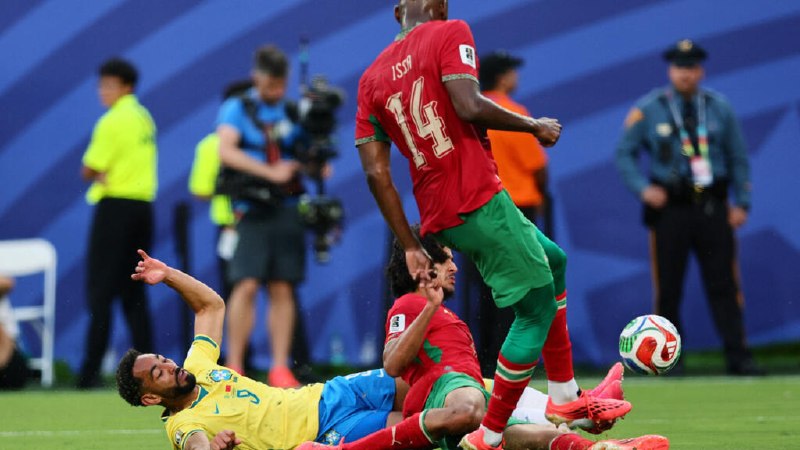
On the evening of 13 June 2026, the sixth match of the 2026 FIFA World Cup kicked off at MetLife Stadium in East Rutherford, New Jersey — the same venue that will host the final — and ended 1-1 between Brazil and Morocco. Ismael Saibari opened the scoring for Morocco in the 22nd minute; Vinícius Júnior equalised before the interval. Both sides spurned clear chances in a second half that did not produce a winner. The result, on paper, is unremarkable. The framing is not. A five-time champion held by a North African side on the world's biggest stage is the kind of scoreline that, in any normal tournament cycle, would dominate the back page for a week. Instead the wire traffic thinned within an hour, the highlights were reduced to a pair of goals, and the structural story — what a Morocco side capable of going toe-to-toe with Brazil in New Jersey says about where world football has actually moved — was left to the margins.
That omission is the story. Brazil–Morocco was not a friendly and not an upset in any defensible sense. It was a Group F fixture between two FIFA-ranked top-twenty sides, played in a stadium that, by FIFA's own marketing, will crown the champion of the tournament in eight weeks' time. The result is a data point in a trend that has been building for the better part of a decade: the gap between the traditional South American and European powers and the rest of the field is narrower than it has been in the professional era. The broadcast and the press cycle have not caught up. They are still organising the story around the names on the back of the shirt.
The match, plainly
According to live updates from GeoPWatch's match thread on Telegram, the game opened with Morocco absorbing early Brazilian pressure and striking first through Saibari at the 22nd minute, with the goal confirmed by teleSUR English on X shortly after. Brazil equalised through Vinícius Júnior before half-time, also reported via the same wire. The second half was described in the live thread as open, with both sides registering missed chances that, in the language of the channel's correspondent, made it one of the better matches of the tournament's opening week. No red cards, no controversies of note, no late winner. The 1-1 line, reported as the final score at roughly 23:36 UTC on 13 June 2026, was the cleanest possible summary of ninety minutes that refused to declare a winner.
The framing FIFA would prefer
The official line, the one that travels through FIFA's communications channels and the federation-aligned press, is that the 2026 tournament is a 48-team celebration of global football, expanded for the first time to include more African, Asian and Caribbean representatives than any World Cup in history. That line is true in the narrow sense: the field is larger, and Morocco's presence in a marquee group-stage fixture with Brazil is the literal proof of the expansion. What the line omits is who those representatives are playing, in which venues, under which federation's commercial roof, and in front of which broadcasters. The answer to all four is: FIFA's. The Moroccan federation does not own a stake in the MetLife advertising boards. The Atlas Lions' equalising goal did not move the price of a European rights package. Theournament's commercial architecture remains, in 2026, exactly what it was in 1994 when the United States last hosted — a Western-rights, Western-venue, Western-broadcast product with a global cast.
The structural read
The deeper point is not that the World Cup is rigged against Morocco. It is that the structural incentives built into the tournament still reward the older federations with the marketing oxygen, while the football itself is increasingly produced elsewhere. A draw with Brazil in New Jersey is, for the Moroccan football project, a statement of arrival. The federation's investment in academy infrastructure, in European-based development for dual-national players, and in coaching pathways that no longer run exclusively through Paris and Lyon has produced a side that can sit in a 4-3-3 against the most expensive attack in the world and walk away with a point. None of that — none of the institutional scaffolding that produced Saibari's run and finish — is a story FIFA's broadcast partners are well-equipped to tell, because the broadcast grammar of the tournament is still built around the Seleção, around Les Bleus, around the Premier League names on the teamsheet. A 1-1 draw in East Rutherford disrupts that grammar. The wire response is to flatten the disruption into a scoreline.
The counter-read, taken seriously
It is worth saying plainly: a single group-stage draw is not, on its own, proof of a reordering. Brazil played without several first-choice starters, and the Brazilian football press, had it been inclined to cover the match at the volume the moment deserved, would have framed the result as a wake-up call rather than a referendum on the world order. The Moroccan side, similarly, will play very different fixtures against sides that do not give Vinícius Júnior the kind of half-spaces he was permitted on Saturday. The honest reading is that the result is one data point in a longer curve — and that the curve is genuinely ambiguous. What is not ambiguous is that the curve exists. Morocco drew with Croatia at the 2022 World Cup, beat Belgium, and reached the semi-finals. They have not regressed since. The 1-1 in East Rutherford is a continuation, not a surprise.
What the wire missed
The standard match report, the kind that will run in the European football pages this week, will treat the result as an interesting note from Group F. The interesting note, properly read, is that the most-watched football tournament on earth played a fixture in New Jersey on 13 June 2026 in which the African side was the more organised defensive unit for the first twenty minutes, the first to score, and the side that walked off the pitch with a result that, three cycles ago, would have been treated as the upset of the tournament. The wire will not say that. This publication will.
The Monexus desk framed this fixture as a structural data point in the long rebalancing of world football — not as a one-off result, and not as a marketing line about globalisation. The dominant wires treated it as a Group F scoreline.
Wire provenance
This editorial synthesis draws on the following public wire/social posts:
- https://t.me/GeoPWatch