Brazil and Morocco trade blows in a heavyweight opener that says more about the World Cup's new geography than the scoreboard
A 1-1 draw at MetLife Stadium gave Brazil their 21st consecutive unbeaten World Cup opener, but the venue, the opponents, and the room said more about the tournament's centre of gravity than the result.
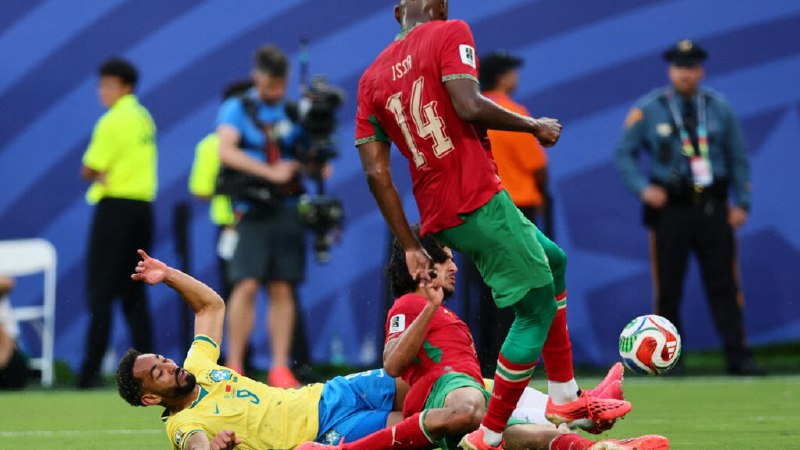
The scoreboard at MetLife Stadium on 14 June 2026 read Brazil 1, Morocco 1, and the most consequential thing about the match was that almost nothing on the pitch behaved the way a heavyweight World Cup opener is supposed to. Brazil, the tournament's most decorated nation, were held. Morocco, a side that did not exist in the imagination of casual global football four years ago, were the team doing most of the dictating for long stretches. And the venue — the same New Jersey bowl that will host the final in five weeks — had been chosen, in part, precisely because it is the kind of stage on which the modern game stages its most symbolic encounters.
A draw in the opening fixture of Group C is rarely the story the broadcasters want from a tournament that has been marketed, above all, as the first World Cup staged across three North American countries. Yet the result, and the way it arrived, tells a more honest story about where the 2026 edition is actually taking place — not just in geography, but in the hierarchy of the game itself. France 24's match report described the contest as one that "kept its promises," a phrase that captures the unromantic truth of a 1-1 in June: both teams left with something, and neither left with the air of a side that had been outclassed.
The match, in shape rather than scoreline
The bare facts are these. Brazil and Morocco drew 1-1 at MetLife Stadium in East Rutherford, New Jersey, in the Group C opener of the 2026 FIFA World Cup. France 24's English and French services both filed the result within the same hour, around 00:07 UTC on 14 June 2026, with the French-language dispatch noting that Vinícius Júnior had responded for Brazil in the first half after Morocco had struck first. The match was played at the venue that will host the World Cup final on 19 July, a deliberate piece of staging that gives any early-tournament draw a particular weight.
Iran's Tasnim news agency, an English-language wire with a global sports desk, framed the result a different way. Its brief, posted at 00:10 UTC under the headline carried in Telegram, was that the draw extended Brazil's unbeaten record in opening matches of World Cup finals to 21 games. That statistic is the kind of number that looks impressive in isolation and meaningless in context; the more telling fact is that 21 of those openers have come against opponents of widely varying quality, and that the more recent entries on the list have been harder than the older ones. Brazil's record books remain intact, but they are being kept intact by teams that would not have given them a game in earlier decades.
What the opponent said about the field
Morocco's presence at a tournament opener of this stature is itself the headline that the post-match desks in Doha, Casablanca, and Paris have been filing for months. The Atlas Lions arrived in North America as the first African and first Arab side to reach a World Cup semi-final, having finished fourth in Qatar in 2022. The squad that takes the field in 2026 is not the same squad that did that work — Achraf Hakimi, Sofyan Amrabat, and Youssef En-Nesyri are still central, but the depth around them has changed, and the head coach has changed with it. Holding Brazil to a draw in the opening match, in the stadium that will stage the final, is a different proposition from a knockout round in Al Khor four years ago.
There is a temptation, in Western coverage of African football, to treat any result against a traditional power as a single-data-point miracle. That framing flatters the incumbent and insults the opponent. Morocco did not draw at MetLife because they were brave and Brazil were nervous; they drew because their defensive block is now organised at a level that several European sides would envy, and because their attacking transitions, led by the pace of their wide players, repeatedly pulled Brazil's back four out of shape. The Brazilian equaliser, per the France 24 French wire, came through Vinícius Júnior — the kind of individual intervention that papers over structural problems rather than solving them.
The new geography of the tournament
The 2026 World Cup is the first to be hosted by three countries — the United States, Mexico, and Canada — and the first to feature 48 teams, up from 32 in Qatar. Both facts matter to this match. The expansion of the field has changed the composition of the groups; a side like Morocco, who four years ago would have been among the seeded or borderline-seeded teams in a 32-team draw, is now one of several African sides that arrive with realistic knockout-stage designs. The three-country hosting model, meanwhile, has concentrated the marquee matches at a smaller number of venues, and MetLife — with its 82,500 capacity and its proximity to the largest media market in North America — is the natural choice for a fixture the organisers want the world to see.
That staging decision has its critics. Caribbean and Central American voices have noted that the tournament's centre of gravity has drifted north, and that the 2026 edition will leave a thinner legacy in Mexico City's Estadio Azteca than the 1970 and 1986 tournaments did. South African and Egyptian outlets have argued, with some justification, that the new format dilutes the meaning of the group stage by guaranteeing more dead rubbers. Both critiques are partly true. Neither changes the fact that the 2026 World Cup is, by design, a tournament organised around the North American broadcast market, and that the matches it treats as marquee will be the matches the world ends up watching.
Stakes beyond the group
Group C will produce, in all likelihood, the second-toughest group in the tournament. Brazil, Morocco, and two further sides that have not yet taken the field in this opening round will contest two of the three knockout places. For Brazil, the draw at MetLife is a warning rather than a crisis: the Seleção have lost only one competitive match in three years, and the squad depth available to their head coach is the deepest in the field. But the warning is real. A team that expects to win the final in this same stadium on 19 July cannot afford to be held to a draw by a side that, on this evidence, has the defensive organisation to frustrate them for ninety minutes.
For Morocco, the point is a foundation rather than a ceiling. The Atlas Lions go into their next group fixture with the knowledge that a draw with Brazil, at the venue that will host the final, has reset the expectations of every neutral who watched the match. Theirs is now a tournament in which the ceiling is defined by the result against Brazil, not by the bracket. That is a subtle but real shift in the geometry of the competition, and it is the part of the story that the 1-1 scoreline, read in isolation, does not capture.
The counter-reading is straightforward. A draw in the opening match tells us little about how either side will perform in the knockout rounds. Brazil have won World Cups on the back of slow starts before — the 2002 side drew their opening match against Turkey and went on to lift the trophy. Morocco have not yet played a knockout match under the new format, and the sample size of one game at a neutral venue is too small to justify grand claims. Both readings are defensible. The honest synthesis is that the draw is consistent with a tournament in which the established order still wins more often than it loses, but in which the margin has narrowed to a point where the opening match of a group can be played on the front foot by a side that, a generation ago, would have been a footnote in the broadcast.
What the sources do not yet tell us is the shape of the two group fixtures that follow, and whether the Brazil midfield, which looked more conservative than its recent tournament appearances, will be rebalanced before the second match. France 24's match report was filed at full time and does not speculate; Tasnim's English wire stopped at the unbeaten-run statistic. The remainder of the picture will be drawn over the next ten days, as the rest of Group C plays, and as the teams that drew at MetLife return to the same surface with different stakes.
How Monexus framed this: The wire services that covered the 1-1 draw led with the result, the venue, and — in Tasnim's case — a record-book stat for Brazil. This piece treats the draw as a window into a tournament whose centre of gravity has moved, both in where the matches are staged and in who can credibly contest them on the field.
Wire provenance
This editorial synthesis draws on the following public wire/social posts:
- https://t.me/tasnimnews_en
- https://t.me/france24_en
- https://t.me/france24_fr
- https://en.wikipedia.org/wiki/2026_FIFA_World_Cup
- https://en.wikipedia.org/wiki/MetLife_Stadium
- https://en.wikipedia.org/wiki/Morocco_at_the_FIFA_World_Cup
- https://en.wikipedia.org/wiki/Brazil_at_the_FIFA_World_Cup