Brazil and Morocco trade blows as World Cup opens with two late twists
A 1-1 draw at MetLife and a stoppage-time equaliser in Group C's opening salvo set the tone for a tournament that will test more than form.
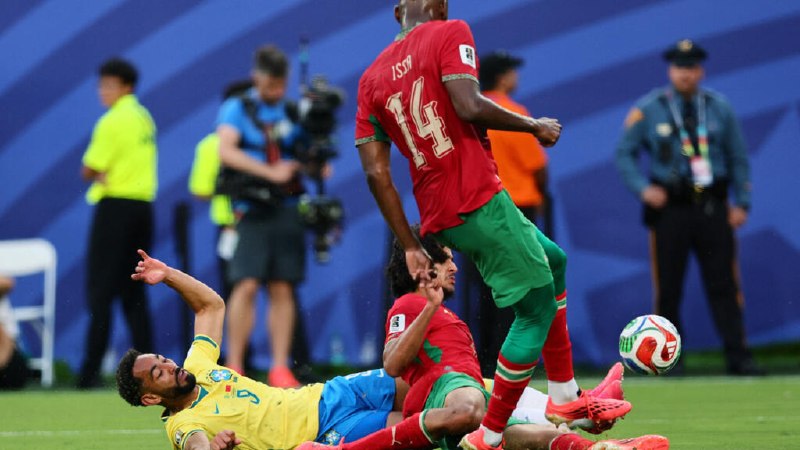
Two matches, two draws, and a tournament that will not wait. On the opening day of the 2026 FIFA World Cup's group phase, the story was not the scoreline but the timing: stoppage-time goals in both fixtures decided the points, and in the process redrew the early Group C ledger. Qatar struck late to rescue a point against Switzerland, while Brazil and Morocco shared the spoils in a tightly contested opener at MetLife Stadium in East Rutherford, New Jersey — the venue already tagged to host the final on 19 July 2026.
The draws carry the same weight for very different reasons. For Brazil, the five-time champions, a 1-1 against a Morocco side that reached the 2022 semi-finals in Qatar is, on paper, the most credible stress test the group stage can offer. For Morocco, the Africans' first match against a South American heavyweight since that run ended in France is a statement of arrival. For Qatar, the defending champions needed every minute of added time to avoid a losing start on home confederation soil. None of the three left the field in crisis. None left comfortable either.
The heavyweight opener
France 24's match report, filed at 00:07 UTC on 14 June, sets the scene: Brazil and Morocco played out a 1-1 draw in their Group C clash at MetLife Stadium, the New York-area venue that will host the World Cup final. Vinícius Júnior opened the scoring for Brazil in the first half, before Morocco drew level in a contest the French broadcaster's English desk described as one that "kept its promises." The report carries the subplot the global audience will read into: this is a Morocco side that no longer treats a draw with Brazil as a ceiling. It treats it as proof of floor.
The tactical reading is more useful than the scoreboard. Brazil controlled territory in spells, with Vinícius operating in the left half-space the way he does for Real Madrid, but the Moroccan press kept a second line of engagement to deny the cut-back. Morocco's equalising sequence, as captured in the French24 French-language bulletin, came from a vertical pass that broke the first line of Brazil's midfield press; the French desk noted the run that dragged the Brazilian right-sided centre-back out of the central channel. This is the kind of goal that costs a half-step, and against a counter-attacking block, a half-step is the match.
The stoppage-time twist in Group C
If the Brazil-Morocco draw was a statement of parity, the late show in the Switzerland-Qatar fixture was a reminder of tournament arithmetic. According to the same cluster of dispatches circulated by teleSUR English and corroborated by the France 24 wire at 00:07 UTC on 14 June, Qatar equalised deep into stoppage time to deny Switzerland an opening-day win. The framing across the four thread items is consistent: two groups, two draws, and everything still to play.
That framing matters. Group C is now shaped by points dropped, not points taken. Brazil, Morocco, Switzerland and Qatar are all on one point after matchday one. A draw-heavy opening round in a four-team group where the top two advance means the permutations compress: any win in the second round turns the table. Any second draw, by contrast, leaves the group open to a six-point swing on the final matchday that could easily see the pre-tournament favourites going home. Switzerland, the seeded European side in the group, will regard a draw against the host confederation's representative as a missed opportunity. Qatar, the defending champions, will regard the same draw as a hand retrieved from a burning table.
Counter-read: why the wire underplays the rotation risk
The dominant wire framing of an opening day is celebratory: goals, drama, late drama, the universality of football. That is fine as colour, but it papers over a structural point. A World Cup played across three host countries — the United States, Mexico and Canada — with 48 teams and an expanded group phase compresses the rest windows between fixtures in ways that make squad rotation, not talent, the single most predictive variable of the knockout rounds. The opening day hinted at it: Brazil's bench included enough Champions League-level talent to alter a game on its own; Morocco's did not, but their starting XI was already closer to first-choice than to a rotated side.
The plausible alternative read is that the wire's breathless tone about stoppage-time drama understates the rotation risk. A team that spends its bench in matchday one chasing an equaliser arrives at matchday three with three days' less recovery than a side that closed out a 1-0. Brazil and Switzerland, the two highest-pedigree sides in the group, both spent energy to avoid losing. Morocco and Qatar spent energy to avoid being beaten. The ledger, after round one, looks similar. By round three, it may not.
Structural frame
The 2026 tournament is the first World Cup staged across three countries and the first with 48 teams. The expansion is more than arithmetic. It redraws the political economy of the global game. African representation has risen to nine or ten slots (the exact figure depends on the inter-continental playoff paths that close the field); Asian representation is up; the Caribbean and Central American minnows have a route that did not exist under the 32-team format. A Morocco that draws with Brazil in New Jersey is, in a structural sense, the visible product of that redistribution. The result is not an upset. It is the new centre of gravity.
The hosting arrangement matters too. The United States is the operational hub; Mexico and Canada are co-hosts in name and in stadium distribution. A final at MetLife — the largest NFL stadium in the country, run by a private operator, with corporate-suite economics that already price out a generation of working-class supporters — is itself a statement about who the World Cup's broadcast partners consider the paying customer to be. The match on the field is a football match. The match off it is a media-rights and stadium-revenue match that FIFA, Fox, and the host federations have spent the last decade negotiating. Both matches are running concurrently.
Stakes
The opening day redraws the tactical map but not yet the political one. The stakes over the next fortnight are conventional: top two from each group advance, and the four-game knockout round that follows will compress talent differentials and reward clubs that have rotated intelligently. The deeper stakes sit in the broadcast and brand layer. A Morocco that reaches the quarter-finals for the second consecutive tournament restructures the commercial logic of African football for the next cycle. A Brazil that exits in the group phase — still improbable after one draw — would mark the first such exit in the country's modern history, with consequences for sponsorship valuations and for the Seleção's brand premium going into 2030.
What remains genuinely uncertain is whether the stoppage-time trend that defined day one is a feature of the format or a coincidence of two fixtures. The expanded group phase adds three minutes of stoppage time in aggregate, on average, relative to the 2022 cycle — a small number that compounds across 72 matches. If the pattern holds, this World Cup will be settled in the minutes the broadcast script does not write. That is, in the end, what makes football the world's most-watched game: the part the producers cannot pre-record.
Desk note: Monexus framed the opening day as a structural moment, not a results round-up. The wire covers it as a colour piece; we read it as a redistribution story — of points, of confederation weight, and of where the game's commercial centre now sits.
Wire provenance
This editorial synthesis draws on the following public wire/social posts:
- https://t.me/telesurenglish
- https://t.me/france24_en
- https://t.me/france24_fr