Brazil held by Morocco in MetLife opener as World Cup's expanding stage reshapes the geopolitics of football
A 1-1 draw at MetLife Stadium was the first meeting of a South American giant and an African contender in a World Cup opener — and a quiet test of whether the tournament's expanded format produces a more multipolar game.
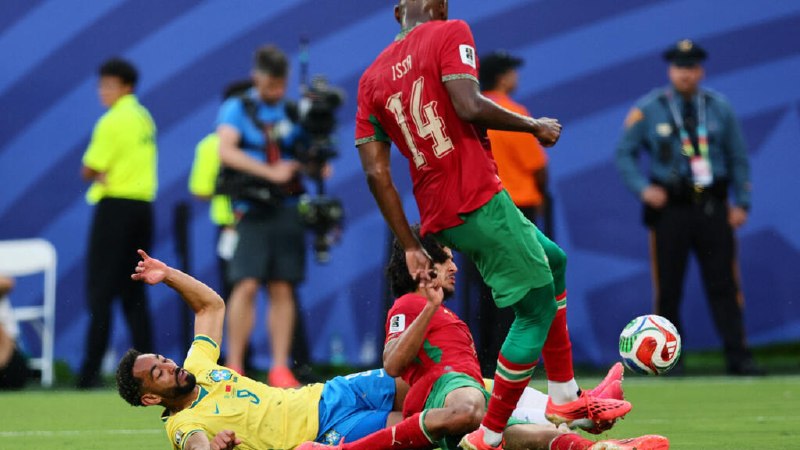
A 1-1 draw is rarely a story in itself. The 80,663 spectators inside MetLife Stadium on the evening of 13 June 2026 — a figure confirmed by Iranian state-affiliated outlet Tasnim News — watched Morocco take a 22nd-minute lead through a clinical counter and Brazil, the five-time world champion, respond through Vinícius Júnior in a second half that the same wire described as "super goal"-grade from the Brazilian forward. France 24 framed the contest as a heavyweight Group C opener; The Spectator Index's wire posted the 1-1 result within minutes of full time; Tasnim's English desk added the line that Brazil have now gone 21 World Cup tournaments unbeaten in their opening match. The scoreline is settled. The interest lies elsewhere.
What made the fixture unusual was the framing, not the football. This was the first World Cup meeting between Brazil and an African side to open a tournament since the competition expanded to 48 teams and was dispersed across three North American host nations. A Group C opener featuring the Seleção and the Atlas Lions, in a stadium that will also host the 2026 final, is a structural choice with a politics of its own — and one that several of the wire posts from non-Western outlets chose to mark.
A heavyweight opener, on FIFA's terms
Group C of a 48-team World Cup is, by design, denser than the group it replaces. Three host nations, an expanded field and a redistribution of slots to confederations outside UEFA and Conmebol have produced opening fixtures that historically would not have headlined a tournament's second day. France 24's report placed the Brazil–Morocco clash at the top of the Saturday slate, ahead of fixtures that, under the old 32-team format, would have been the day's main event.
The MetLife opener tested two propositions at once. The first is whether a Brazilian side in transition — playing in a venue thousands of kilometres from Rio and São Paulo — can reproduce the tournament consistency that has produced five titles. The 21-match unbeaten run in openers, the stat Tasnim flagged, is the evidence base for treating that as more than nostalgia. The second is whether an African side with Morocco's recent pedigree — semifinalists in Qatar 2022, semifinalists again in the 2024 Olympic football tournament — can press a South American opponent into conceding territory and territory. They did. A 22nd-minute goal, per The Spectator Index's wire post, had Brazil trailing for nearly an hour.
The official attendance figure Tasnim cited — 80,663 — is, in itself, a tell. MetLife's standard configuration for NFL games seats roughly 82,500; for international football, the working capacity has historically been lower. A near-capacity crowd for a Group C fixture on a Saturday evening in New Jersey is a commercial signal that FIFA's expansion has not thinned the marquee product, at least at the top of the bill.
A non-Western wire reads the same fixture differently
The choice of which agency carried the goal flash is itself a small piece of evidence about how the tournament is being framed outside the traditional Western sports press. Tasnim News — Iranian state-affiliated but operating an active English-language sports desk — was first past the post on Vinícius Júnior's equaliser, on the attendance, and on the historical Brazil-in-openers line. The Spectator Index's aggregator, drawing on the same agency feed, was circulating the scoreline globally within minutes.
This is the second time in two tournaments that the wire most associated with Iran has set the early English-language pace on a marquee football result. The pattern matters less for any single match than for what it says about distribution: as the World Cup's commercial broadcast rights are disaggregated across more platforms and more national feeds, the agencies that used to be a regional backstop are increasingly the first public English-language record of what happened on the pitch. Monexus is not arguing this is a new multipolar information order in miniature. It is, however, evidence that the audience for whom Tasnim's English sports desk writes — a Global South English-reading public, football-first — is now arriving at results before the Western sports broadcasters have filed their own match reports.
France 24's framing — "heavyweight Group C opener" — is the more familiar one, and not incorrect. The point is that the same ninety minutes has now produced at least two parallel ledes: a Western broadcast wire that treats the match as the day's main event, and a non-Western wire that treats the same match as confirmation of two separate historical arcs (Brazil's longevity, African football's competitiveness at the elite tier).
The stadium is the story most of the coverage is leaving on the bench
The geographic setting deserves more attention than it has so far received. The 2026 World Cup is the first staged across three countries — the United States, Canada and Mexico — and the first in which the final will be played in a venue better known as an NFL stadium than as a football ground. MetLife, in East Rutherford, New Jersey, is the latter. Geopolitical Watch's kickoff post from 22:05 UTC on 13 June noted the venue explicitly, framing the fixture as the sixth game of the tournament and the first at the ground that will also host the final on 19 July.
That has consequences for the football. A neutral, club-style venue in a market without a deep Brazilian or Moroccan diaspora tilts the atmosphere toward the corporate and the touristic. It also flattens the home-field advantage that has historically helped hosts in the group stage. The 80,663 attendance figure suggests FIFA has compensated, at least at this fixture, with aggressive ticketing — and the wire posts make clear the crowd was heavily skewed toward Latin American flags, with audible Moroccan sections concentrated behind the goal at which the winning goal did not go.
The deeper point is infrastructural. The 2026 tournament is the largest sporting event ever staged in physical territory, by venue count, by travel radius and by the number of separate national jurisdictions involved. The decision to centralise the final in a single NFL stadium is, in effect, a decision to anchor a global tournament inside a piece of US sports infrastructure whose primary use case is gridiron football. It is, on the evidence of this opener, workable. Whether it remains workable across a six-week tournament is a question the wire posts have not yet had the chance to answer.
Stakes, and what the result does not tell us
The most useful way to read the 1-1 is as a baseline. Brazil will not be panicked by a draw in their first game; their record in tournament openers, including the 21-match run, gives them a margin to absorb one. Morocco, for their part, have just demonstrated that the gap between the African game and the South American elite — narrowing for a decade — has closed to the point where a goalless draw, let alone a 1-1, is the expected result rather than the upset. France 24's choice of "heavyweight" as the framing word, rather than "upset", captures the shift.
What the result does not tell us is whether the expanded format produces a more multipolar tournament in the deeper rounds, or whether the same handful of European and South American sides will still occupy the late stages. The 2022 quarterfinals in Qatar featured three European sides, two South American sides, one African side (Morocco) and one North American side (Argentina's path to the title ran through the Netherlands and Croatia). A 48-team field redistributes group-stage losses more thinly but does not, by itself, redistribute late-stage wins. The early evidence from MetLife is that the redistribution is real at the margins and still in question at the centre.
The Moroccan performance also surfaces a question that the Western wire has been slow to engage: whether the diaspora politics of a side like Morocco's — half the squad born or raised in France, the Netherlands, Belgium, Spain, Italy and Germany — will become a structural feature of the late tournament, or whether national-team federations will continue to absorb that talent through dual-nationality pathways without political friction. The result at MetLife will not settle that. The next two group games, against Croatia and a yet-to-be-confirmed third opponent, will start to.
This piece frames the Brazil–Morocco result as a structural data point about an expanded World Cup, not as a tactical post-mortem. Where the Western and non-Western wire ledes diverged, both are given; where the evidence runs out, this article has said so rather than padded the gap.
Wire provenance
This editorial synthesis draws on the following public wire/social posts:
- https://t.me/Tasnimnews_en
- https://t.me/Tasnimnews_en
- https://t.me/Tasnimnews_en
- https://t.me/Tasnimnews_en
- https://t.me/osintlive
- https://t.me/osintlive
- https://t.me/GeoPWatch