Drone strike on northern Israeli military site marks a quieter escalation
Israeli army radio published imagery of a drone striking a military installation in the West Galilee on 14 June 2026, the latest in a slow-burn aerial exchange along the northern border.
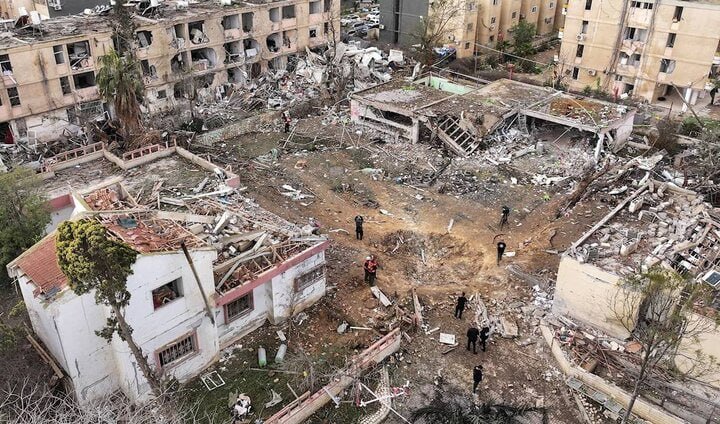
Israeli army radio on 14 June 2026 published imagery of what it described as a drone strike on a military installation in the West Galilee, the northern stretch of territory bordering Lebanon. The pictures — picked up by Iranian and Iran-aligned outlets within the hour — are the most concrete visual evidence to date of a small but persistent aerial campaign that has been trading back and forth across the frontier since the Gaza war began. The Israeli military had not, as of 05:40 UTC, issued a public casualty or damage assessment from the affected site; the immediate framing in the regional press treated the strike as a calibrated message rather than a battlefield turning point.
The episode is best read not as an event but as a tempo. For nearly two years the Israel-Lebanon border has absorbed a low-altitude war of interceptors, surface-to-air missiles, and one-way attack drones. The 14 June incident fits that rhythm: a single airframe, a published target, a claim of impact, and a rapid information loop that pulled Israeli military media, Iranian state broadcasters, and pan-Arab outlets into a single conversation before the Israeli press desk had filed its first line.
What the reporting shows
The thread that surfaced the incident is narrow but consistent. At 05:18 UTC, al-Alam, the Arabic-language channel of Iranian state television, reported warning sirens activated on the "Bitest" beach in the north, citing Israeli media. By 05:40 UTC, Iran's Tasnim News Agency and its English service had carried the more specific claim: Israeli army radio had published images of a drone striking a military site in the West Galilee. By 05:48 UTC, al-Alam had republished the same footage. By 06:11 UTC, Iran's Mehr News Agency was running a video version of the claim. The whole sequence — first warning, then visual evidence, then Iranian state amplification — completed in under an hour, in the small hours of an Israeli morning.
What is missing from the public record is just as telling. The Israeli Defence Forces spokesperson's unit had not posted a confirmation on the struck site, and the army radio images — almost certainly released by the IDF's own media arm — did not, in the frames circulated, show clear damage or a fire plume. Iranian outlets described the target as a "military site" without naming a unit, base, or installation. There is no independent verification, in the materials available to this publication, of casualties, weapons type, or launch origin.
The counter-frame, Iranian and Arab
Reporting from the Iranian side is built for a domestic audience that has been told, since late 2023, that the "resistance axis" retains the capacity to strike deep into Israeli territory. The Mehr and Tasnim coverage uses the language of "the invading Israeli army" and the "Zionist regime" — terminology that frames the strike as retaliation for an ongoing occupation, not as a fresh aggression. In that frame, the West Galilee strike is a routine act of deterrence: proof that Israeli air defences can be penetrated, that the country's northern flank is not impregnable, and that the cost of the Gaza campaign continues to compound.
The structural argument implicit in the Iranian coverage is that a war of attrition on the northern border is being prosecuted by a coalition that includes Hezbollah's residual precision-strike capacity, Iraqi and Yemeni factions, and Iranian intelligence. Israeli military correspondents have, in past reporting, attributed similar small drone interceptions to Hezbollah's air wing; the 14 June strike has not yet been claimed by any specific faction in the materials reviewed by this publication.
Why the slow tempo matters
A single drone on a military site in the West Galilee is, in itself, a small event. Read against the broader 2026 pattern, it is part of a campaign that has shaped Israeli defence budgeting, the operational tempo of the Northern Command, and the political pressure on the government in Jerusalem to find a diplomatic off-ramp. The Israeli public has grown inured to northern alerts; the political class has not. Every successful penetration, even a small one, feeds the argument inside the security cabinet that the current arrangement is unsustainable.
The information dimension is at least as important as the physical one. Israeli army radio, by publishing imagery of the strike site, is performing transparency for a domestic audience that has been told repeatedly that the country's air defence network is the best in the world. Iranian state outlets, by republishing the same frames with hostile framing, are performing a different kind of transparency for their own audience: proof that the most-monitored airspace in the Middle East can be crossed by a single airframe, and that the Islamic Republic's regional deterrent architecture still functions. Both sides need the strike to be visible; both sides therefore release it.
What remains uncertain
Three questions will determine whether 14 June becomes a footnote or a marker. First, attribution: no faction has claimed the airframe in the public record reviewed here, and Israeli sources have not named a launch point. Second, consequence: the Israeli military has not yet quantified damage, and the absence of a casualty announcement is consistent with a near-miss or a soft-target hit rather than a strike on a hardened facility. Third, response: the more interesting variable is what the Northern Command does in the hours and days that follow — a retaliatory strike into Lebanon, a quiet diplomatic channel through UNIFIL, or the maintained silence that has characterised the past several months of managed escalation.
What the sources do agree on is the fact of the strike itself. A drone reached a military site in the West Galilee in the early hours of 14 June 2026; Israeli army radio confirmed the impact visually; the broader public record will follow once the IDF spokesperson's office, the Home Front Command, and the air force have decided what to release. Until then, the strike is both an event and a framing exercise — and the framing, for now, is being written faster than the facts are being verified.
This publication reviewed the cluster as wire provenance: the only primary materials circulated in the originating thread were the Iranian-state Telegram channels and a single alert from al-Alam. Any subsequent Western or Israeli wire confirmation will, in line with our sourcing policy, supersede this account.
Wire provenance
This editorial synthesis draws on the following public wire/social posts:
- https://t.me/mehrnews/
- https://t.me/alalamfa/
- https://t.me/tasnimnews_en/
- https://t.me/JahanTasnim/
- https://t.me/alalamfa/