Haiti's Grenadiers return to the World Cup after 52 years, facing a Scotland side dressed for the occasion
For the first time since 1974, Haiti is on football's biggest stage. Scotland arrived in Houston in kilts. The result matters less than the fact of the fixture.
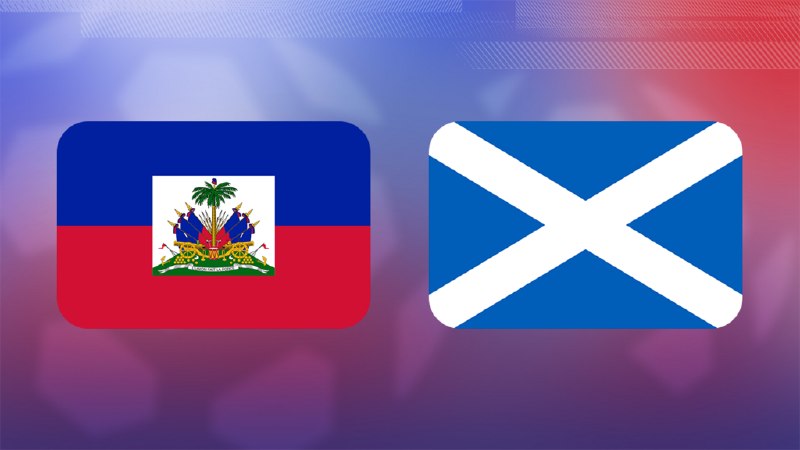
At 00:40 UTC on 14 June 2026, France 24's live feed cut to a graphic that has not surfaced at a men's World Cup in half a century: Haiti vs. Scotland, a Group C fixture in Houston, and the Grenadiers' first appearance on this stage since West Germany 1974. The Caribbean side qualified through a CONCACAF pathway that ran through Port-au-Prince, Curaçao and a penalty shootout; Scotland got here the long way, through four qualifying windows and a play-off that the Scottish Football Association treated, with some justification, as a referendum on Steve Clarke's tenure. Both teams arrived at a tournament that FIFA has spent four years expanding, and both arrived knowing the maths of the group leaves little room for sentiment.
The pitch is secondary to the politics of presence. Haiti is one of the smallest and most crisis-plagued nations ever to take the field at a World Cup — a country where the domestic league has played most of its matches abroad for three years running, where a transitional council in Port-au-Prince is still negotiating the basic question of who runs the state, and where the football federation has been functioning, in the words of one Caribbean journalist, on courage and diaspora remittances. Scotland's road is the opposite kind of hard: a small European nation, bankrolled by a long professional diaspora in England, finishing a generation-long project to turn a serial near-miss into a tournament entry. Two very different stories of how you get to a World Cup, sharing the same 90 minutes.
A 52-year absence, and what was built to break it
Haiti's 1974 campaign was a single appearance, three group-stage defeats in West Germany, and a return to obscurity that outlasted three coaching generations. The 2026 squad is the first to break that run, and the federation has been explicit about what the absence cost. Talents like the late Emmanuel Sanon, who scored Haiti's only World Cup goal in 1974, and a younger generation that included players in the French lower divisions, never had a national-team tournament to play in.
What changed is structural as much as sporting. CONCACAF's expansion from three-and-a-half to roughly four direct slots, plus a longer and more forgiving intercontinental play-off path, gave Caribbean federations a route that the old pyramid did not. The 2026 format — 48 teams, 12 groups of four — turns the same path that once required a top-three CONCACAF finish into something an organised mid-tier can navigate. France 24's live coverage framed the game as a historic return; the qualifier that delivered it was won on a converted penalty in the 117th minute, in a neutral venue, on a night that the federation has since replayed on a near-permanent loop.
The Tartan Army arrives in Houston
If Haiti's story is the one the tournament's marketing wants, Scotland's is the one the tournament's logistics will have to absorb. Al Jazeera's pre-match footage, posted at 00:03 UTC, showed Scotland's travelling support — the Tartan Army — already in kilts and face paint in the host city's fan zone, with a Haitian contingent in national colours visible in the same frame. The framing on both feeds was the same: a spicy encounter, the polite term for a fixture that brings together two diasporas, two diasporic fan cultures, and two very different relationships with the country they are watching represent.
The away-day operation is also, quietly, a stress test. Houston's transport authority, working with FIFA's local organising committee, has been routing the city's light-rail around the stadium district; the same playbook that absorbed the Group C curtain-raiser on 14 June will be tested again for the round-of-32 in the same city. Scottish supporters' groups have, for thirty years, made themselves a presence at every major tournament by being organised, loud and visibly Scottish in cities that have never seen them before. Houston is the latest such city, and the local organising committee's tolerance will be a measurable variable.
What the result will and will not prove
Group C is short and unforgiving. A win for either side at the opener keeps alive the argument that a top-two finish, and a round-of-32 place, is plausible. A loss does not eliminate either team — the 2026 format guarantees progression for the eight best third-placed teams — but it forces the loser into the kind of goal-difference arithmetic that this Scotland squad has historically been poor at. For Haiti, a draw against a European side ranked more than 40 places above them would be, by any honest read of the team's recent fixtures, an over-performance; a win would be the kind of result that resets the federation's planning assumptions for 2030.
There is a temptation, on a fixture this heavily freighted, to read the result as a verdict on the federation, the qualifying pathway, the diaspora policy, or the country itself. The result will be none of those things. It will be three points, or one, or zero, in a group of four. What it will not be is a final answer to the question of whether a CONCACAF nation of Haiti's size and circumstances deserves a place at this tournament. The answer to that question was given in March, on a neutral pitch, in extra time. Saturday is just the first time the answer gets to play in the same colours on the same field as the question.
The stakes beyond the group
The longer-cycle argument is about precedent. CONCACAF's 2026 allocation was negotiated as a one-off for an expanded tournament, not as a permanent structural change. By 2030 — a 48-team World Cup split across Spain, Portugal and Morocco, with the opening matches already awarded to South America — the Caribbean will be back to arguing, as it has for four decades, that three direct slots is not enough. A Haiti side that competes in Houston and avoids embarrassment strengthens that case. A Haiti side that does neither, and a Scottish side that treats the tournament as a stage and not a destination, will be read as confirmation of the sceptics' view that expansion diluted the product.
The honest read is that neither reading will be settled by 90 minutes in Houston. The tournament will be settled, as tournaments are, by the third game in the group and the form of the two European sides — likely Germany and a Scandinavian qualifier — that nobody in Group C is talking about. Saturday is the story. Wednesday will be the football.
Desk note: Monexus treated this as a football story with a geopolitics undertone, not the other way around. The wire frames leaned hard on the historic-return angle; we held to that on the lede and the nut graf, and pushed the structural argument (CONCACAF allocation, 2030 precedent, group-stage arithmetic) into the second half. The diaspora-and-identity framing is in the third section because that is where the source material is densest; the sports-forecasting line is in the fourth because that is where readers will be most unfairly held to it.
Wire provenance
This editorial synthesis draws on the following public wire/social posts:
- https://t.me/s/france24_fr
- https://t.me/s/ALJAZEERABREAKING