Haiti end 52-year World Cup absence as Scotland edge a tight opener in the 2026 group stage
Haiti returned to the World Cup for the first time since 1974 on 14 June 2026, falling 1-0 to Scotland on a John McGinn strike that settled a match the Caribbean side had started the brighter of the two.
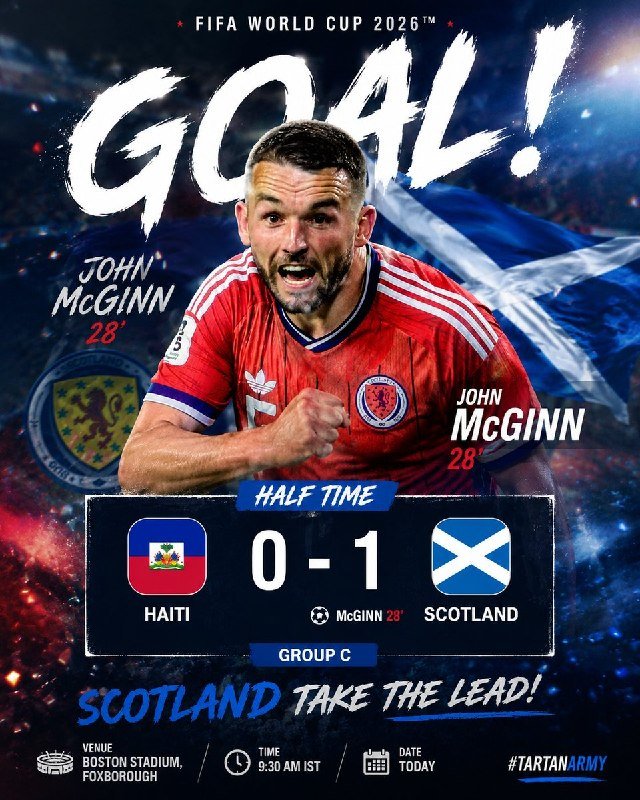
For 52 years, the question went unanswered. Haitian footballers had kicked around the Caribbean, competed in Gold Cups, turned out for clubs in Ligue 1, the Eredivisie and the Championship, and yet the national team had not been on a World Cup pitch since a 1974 group-stage exit in West Germany. On 14 June 2026, that absence ended. The cost of ending it was a 1-0 defeat: John McGinn's goal, scored after Haiti had started the match the brighter of the two sides, separated Steve Clarke's Scotland from a Haitian team playing the loosest, most confident football in its recent memory.
The result, narrow and slightly misleading, papers over a story that has very little to do with the final scoreline. Haiti, a country whose federation has spent much of the last decade wrestling with FIFA over governance and whose domestic league is held together by institutional improvisation, has reached a World Cup at all. That is the lede. The McGinn goal is the footnote.
How the match actually went
Haiti started fast. The opening 20 minutes belonged to the Caribbean side, who pressed Scotland high, won second balls in midfield and forced John Souttar and his centre-back partner to play in front of a noisy defensive line. By the time McGinn struck, the pattern of the game had already bent back the other way: Scotland had grown into possession, found space between Haiti's midfield and back four, and begun to dictate territory. According to a minute-by-minute account carried by TeleSUR English, the goal came after "Scotland grew into the match following Haiti's bright start." McGinn found the net; the same outlet later noted that the Aston Villa midfielder came close to doubling the lead inside the box, only to drag his effort wide of the right post.
France 24's running report corroborated the sequence — McGinn's opener, Scotland "edging past" Haiti, the sense of a match tightening rather than opening up after the goal. By full time the scoreline read Scotland 1, Haiti 0, and the Haitian players, according to Reuters' dispatch on the night, left the field to the sound of their supporters still singing.
What the 52-year gap actually meant
It is worth stating the scale of the absence. Haiti qualified for West Germany 1974 and lost all three group games — to Italy, Argentina and Poland — and has not been back since. In the interim, the country has produced genuine top-flight talent: the generation that included players like Ricardo Adé, Duckens Nazon and, more recently, the forward lines that fired qualifying campaigns in 2023 and 2025, kept Haitian football visible at club level even when the national team had no fixtures that mattered on a world stage. Reuters' lead on Sunday night framed the return in exactly that register — the headline read "Haiti fans pick up the beat as 52-year World Cup hoodoo ends."
There is a second story inside that gap, and it is structural. Haitian football has spent much of the last decade under FIFA's heightened scrutiny, with the federation dealing with governance reforms, normalisation committee processes and the slow, contested work of rebuilding institutional credibility. The team's path to the 2026 tournament — played out across a 12-team CONCACAF field that now offers more direct slots than at any previous World Cup — is the result of both on-pitch qualifying form and off-pitch administrative rebuilding. The wire copy captures the first half of that story. The administrative half is mostly absent from it.
The framing problem: who gets to be a debutant
The mainstream sports media's reflex in any group-stage opener is to treat one team as the story and the other as the opposition. On Sunday that pattern produced a slightly lopsided read: McGinn's goal, Scotland's first World Cup match since 1998, Steve Clarke's relief, the Premier League pedigree of Scotland's squad. All true. None of it is the more interesting story.
The interesting story is that a country of roughly 11.5 million people, with limited federation resources, no fully professional domestic top flight and a security environment that has complicated even routine training camps, has placed a team on the biggest football stage on earth. The counter-frame to consider is whether the optics of a 1-0 loss — narrow, respectable, on a single moment of midfield quality — flatter the actual margin between these two programmes. Scotland has a deeper player pool, more top-flight minutes across its squad, and a manager in Clarke who has now taken the side to consecutive major tournaments. The 1-0 scoreline probably flatters Haiti less than the post-match tenor suggests. The wire coverage, focusing on the run, the return and the atmosphere, does not always make that distinction.
Stakes and what to watch next
For Haiti, the World Cup is not a one-off. The expanded 48-team format gives the Caribbean federation a real chance to convert this appearance into a sustained presence — a second consecutive qualification cycle becomes a credible target if the cohort of current players stays intact and the federation's institutional rebuilding holds. The players who took the field on Sunday are young enough to be in the next cycle. The federation's task is to keep them visible to European clubs and to keep the qualifying pathway open.
For Scotland, the calculus is narrower. A single-goal win over a returning side is the kind of result that keeps a group stage moving without answering any of the harder questions about whether this squad can progress past the round of 32. Clarke's team will be judged on what comes next, not on what happened on 14 June 2026. The thread that matters is whether Scotland can translate control into goals; on Sunday they did, exactly once.
What remains genuinely uncertain is the depth of both squads. The sources do not specify injury updates, squad rotation plans for the second group match, or the competitive state of either side's reserves. That information will arrive in the next 72 hours. Until then, the line on Sunday night is this: Haiti came back. They lost. The two facts, taken together, are larger than either one alone.
Desk note: Monexus framed this opener around the structural weight of Haiti's return — the 52-year absence, the federation's institutional rebuild, the asymmetry between the two footballing projects — rather than the goal that decided it. Wire copy led with McGinn and with the atmosphere; we read those dispatches and pushed the analysis one layer down.
Wire provenance
This editorial synthesis draws on the following public wire/social posts:
- http://reut.rs/3RYpmSK
- https://t.me/telesurenglish
- https://t.me/FIFAcom
- https://t.me/TheAthletic