IDF pushes into southern Lebanese towns as Hezbollah claims Merkava strike
Clashes in Majdal Zoun and Kfar Tebnit on 13 June 2026 mark a new phase of ground operations north of the Litani, with both sides trading claims of battlefield gains.
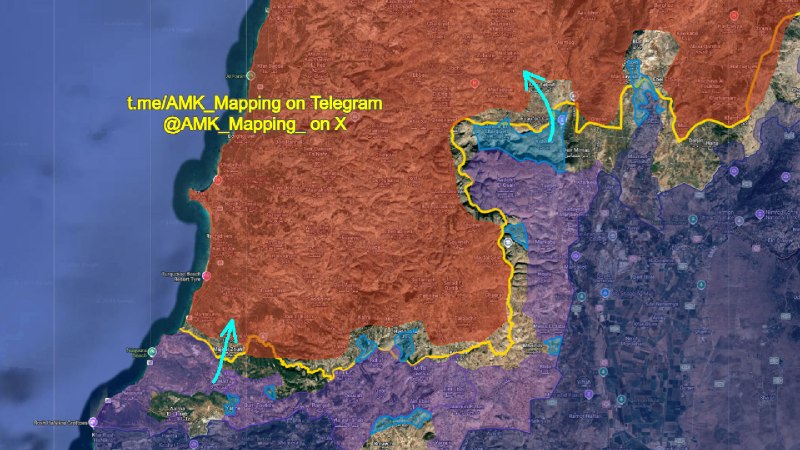
The Israel Defense Forces expanded ground operations into two towns in southern Lebanon on the evening of 13 June 2026, advancing into Kfar Tebnit and Majdal Zoun after extensive airstrikes and artillery bombardment, according to the war-monitoring channel AMK Mapping and the open-source account wfwitness on Telegram. The towns sit north of the Litani River, inside the zone from which UN Security Council Resolution 1701 requires armed groups other than the Lebanese state to withdraw.
In a final statement circulated at 19:20 UTC, Hezbollah said its fighters had targeted Israeli positions in southern Lebanon "in response to Israeli ceasefire violations and in our right to resist," and separately claimed responsibility for a guided-missile strike on an Israeli Merkava tank in Majdal Zoun. Footage aired at 19:45 and 20:47 UTC by wfwitness and relayed by AMK Mapping shows what appears to be a Merkava hit by a Hezbollah anti-tank guided missile during clashes in the same town. The clips have not been independently authenticated, and the IDF had not, as of publication, issued confirmation of vehicle losses in the sector.
A widening ground footprint
The push into Kfar Tebnit and Majdal Zoun extends the IDF's footprint further north than the cluster of border villages that defined the operational map through the spring. AMK Mapping's 19:08 UTC post described the move as the product of "extensive airstrikes and artillery bombardment" preceding the ground advance — a sequencing consistent with Israeli doctrine of shaping terrain before armour and infantry cross the line of departure. The phrasing matters: the IDF is no longer describing its activity as a limited commando raid cycle, and the distance from the Blue Line suggests the operation is intended to hold ground, not merely strike and withdraw.
Hezbollah's own framing — that the attacks are a riposte to "ceasefire violations" — points to the central factual dispute. Israeli officials have, throughout the post-November 2024 period, accused the Iran-aligned group of rebuilding its northern front in violation of understandings reached at the end of the 2023–24 war. Hezbollah, in turn, has treated Israeli overflights and village-targeted strikes as the violation that justifies reactivation. Both narratives are internally coherent; the operational reality is that exchanges of fire have been continuous, even on days officially described as calm.
What the footage does and does not show
The two pieces of video circulating on 13 June — one from wfwitness timestamped 19:45 UTC, the other from intelslava timestamped 22:47 UTC the same day — both purport to show a Hezbollah anti-tank missile hitting an IDF vehicle in Majdal Zoun. The angle is consistent across the two clips, suggesting a shared point of origin. What cannot be confirmed from open-source video alone is the type of warhead used, the precise model of vehicle hit, or whether the strike resulted in a mobility kill, a catastrophic kill, or a near-miss. Combat footage from southern Lebanon has, in past rounds of fighting, been edited to exaggerate outcomes, and Hezbollah-aligned outlets have an interest in claiming successful strikes against Merkava armour, which is among the most heavily protected main battle tanks in the world.
Equally, the absence of an Israeli confirmation is not, on its own, evidence that the strike was fabricated. The IDF rarely confirms equipment losses in real time during active ground operations; public acknowledgement typically follows an internal investigation, sometimes days later. Readers should treat the claim of a confirmed kill as preliminary until corroborated by the IDF, by an independent OSINT analyst with access to geolocation data, or by post-strike imagery of the vehicle.
The strategic picture, in plain terms
The fighting in southern Lebanon sits inside a larger pattern that has hardened since the November 2024 arrangement. The implicit bargain — that Israel would restrain the tempo of strikes in exchange for Hezbollah withdrawing heavy assets north of the Litani — has frayed on both sides. Each side treats the other's infractions as the operative fact; each frames its own response as defensive. That mutual framing is itself the story. When two antagonists both describe the same exchange as retaliation, escalation becomes self-justifying on a near-daily basis.
The structural backdrop is a regional one. Hezbollah retains a missile and drone arsenal that, even degraded, imposes costs on northern Israeli towns and on the Israeli air-defence envelope. Israel retains air superiority and the capacity to escalate strikes against the group's command nodes in Beirut's southern suburbs, the Beqaa Valley, and further north. The southern Lebanese civilian population, displaced repeatedly since October 2023, sits between those two capabilities. On 13 June there were no immediate reports of large-scale new displacement from the two towns named, but airstrikes across southern Lebanon in recent weeks have driven more than 100,000 people from their homes, according to UN tracking, and the front is fluid.
What remains contested
The sources available to Monexus on the evening of 13 June 2026 do not establish three things that matter for a complete picture. First, the number of IDF casualties, if any, from the reported Merkava strike. Second, the scale of Hezbollah losses in Kfar Tebnit and Majdal Zoun, where Israeli ground forces are now operating. Third, whether the ground incursion is a limited sweep intended to dismantle anti-tank positions, or the leading edge of a deeper operation intended to hold the two towns as a buffer. The IDF's own communiqués on the operation, when they appear, will be the decisive document on point three; until then, the available reporting supports describing the move as an expansion of ground operations, not a full reoccupation.
The most that can be said with confidence is that on the night of 13 June 2026, the line between Israeli and Hezbollah-held territory in southern Lebanon shifted, that the shift was the product of deliberate Israeli ground manoeuvre supported by air and artillery, and that Hezbollah's response — including a claimed guided-missile strike on a Merkava — was prepared, publicised in near-real-time, and framed by the group as retaliation. Whether either side's framing of the day holds in the historical record will depend on corroboration that the open-source record, on this night, does not yet supply.
Desk note: Monexus is treating the Hezbollah-aligned Telegram channels wfwitness and intelslava as primary sources for the group's claims, and AMK Mapping as a war-monitoring aggregator whose claims about IDF movements are also presented with attribution rather than as neutral fact. Western wire confirmation of the Majdal Zoun and Kfar Tebnit ground incursion was not available at time of publication; the article will be updated when the IDF spokesperson's office publishes a formal operational update.
Wire provenance
This editorial synthesis draws on the following public wire/social posts:
- https://t.me/AMK_Mapping
- https://t.me/wfwitness
- https://t.me/wfwitness
- https://t.me/AMK_Mapping
- https://t.me/intelslava