Trump claims Iran deal to reopen Strait of Hormuz by Sunday; Tehran silent, sirens heard off Sirik
A US readout describes the proposed agreement as 'fantastic and very strong,' but Iran has not confirmed timing and explosions were reported near Sirik hours before the announcement.
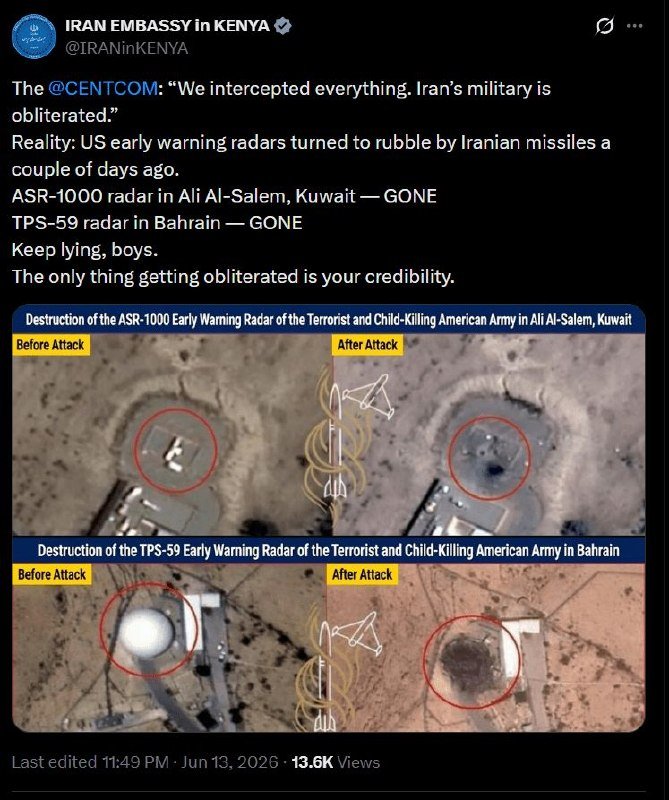
Explosions were audible in the early hours of 14 June 2026 along the Iranian coast near Sirik, in the Strait of Hormuz, hours after the Trump administration told Fox News that a deal with Tehran to reopen the waterway was "fantastic and very strong." The sound of blasts, reported by the open-source channel GeoPWatch at 00:17 UTC, came against a backdrop of mutually incompatible claims: the White House says an agreement will be announced on Sunday; Iran has not publicly confirmed the timing.
The pattern is the story. A US administration trumpets a diplomatic breakthrough on a flagship cable network; the Iranian side refuses to validate it; independent observers on the ground report kinetic activity in the very corridor the deal is supposed to demilitarise. The proposal, as described by a senior US official to Fox, would see Iran reopen the Strait of Hormuz without conditions — a concession that, on its face, would unwind a month of pressure on global oil markets. Tehran's silence, twenty-four hours before the supposed signing, leaves the proposition unconfirmed at the source.
What the US is claiming
The clearest read-out comes from a 23:59 UTC, 13 June 2026 Fox appearance, relayed by the World Feed witness channel: a senior US administration official characterised the proposed agreement as "fantastic and very strong," and said its core provision is that Iran reopen the Strait of Hormuz without the imposition of new conditions. President Donald Trump separately told reporters, per Middle East Eye, that the deal would be concluded "on Sunday" and would resolve the Hormuz question. The White House has not, as of the most recent Middle East Eye wire, published a text or a joint statement.
The asymmetry of the two readouts is itself the news. The US side has put a substantive claim on the record — a Hormuz reopening, with no Iranian preconditions — without producing a document. The Iranian side, by declining to confirm the timing, has effectively put a question mark over whether the deal exists in the form described.
What Iran has — and has not — said
Middle East Eye's 22:29 UTC, 13 June report frames the dispute plainly: Trump says the deal is set for Sunday; Tehran has yet to confirm. Iranian state-aligned outlets have, in the hours since, not carried a parallel announcement. The silence is conspicuous because both the cost of reopening Hormuz to Iran and the cost of keeping it closed are large enough that a confirmed deal would, on past form, be televised in Tehran.
Two readings compete. The first is that the diplomatic text is essentially settled and that the Iranian delay is a domestic-political calibration inside the Islamic Republic — a posture familiar from earlier rounds of nuclear negotiations, where Tehran allows a face-saving interval between an American announcement and an Iranian confirmation. The second, less comfortable reading is that no deal exists in the form the administration has described, and that the Fox appearance is a US-led shape-of-the-deal briefing aimed at moving markets and constraining Tehran's negotiating space. The available source material does not let this publication adjudicate between the two.
What happened near Sirik
The open-source channel GeoPWatch reported explosions in the Strait of Hormuz off the coast of Sirik at 00:17 UTC on 14 June 2026. The post did not specify the origin of the blasts, the target, or the warring party. Sirik sits on the Iranian side of the strait, in Hormozgan Province, on the southern coast; the chokepoint at its narrowest is roughly 33 nautical miles wide, with shipping lanes on either side of a two-mile buffer.
The reports are not corroborated in the available thread material by Reuters, the BBC, the Guardian, Al Jazeera, or any of the wires this publication uses as tier-one confirmation. That is a non-trivial caveat. Open-source channels monitoring the strait have, in prior flare-ups, sometimes led wire reporting by minutes and sometimes by hours; in other cases, their reports have been overtaken by a fuller picture. Monexus treats the Sirik account as credible-but-unverified until a wire confirmation is on the wire.
The structural point holds either way. Even a successful Hormuz deal would be layered on top of a security environment in which, on the eve of signing, kinetic events are occurring in the corridor the deal is supposed to demilitarise. A reopened strait is a commercial fact; whether it is safe to transit is a separate, military one.
The pattern, in plain terms
The familiar cycle runs: sanctions pressure builds, oil markets tighten, a diplomatic channel opens, an American official describes a deal in optimistic terms, the Iranian side neither confirms nor denies on the same timetable, and the gap between announcement and confirmation becomes a market-moving event in its own right. That cycle is now playing out in the public sphere with unusual speed, on a chokepoint through which roughly a fifth of seaborne oil passes. Energy benchmarks — not named here because the source items do not provide a current print — react in real time to the gap between what Washington says is true and what Tehran will say is true.
The bigger structural frame: the United States retains the capacity to set the schedule of a major diplomatic event, including the announcement of its own success, on a schedule independent of its counterpart. That is not, in itself, evidence of a deal. It is evidence of a particular kind of information asymmetry — one in which the side with the louder megaphone can move price and constrain the other party's negotiating room before the other party has spoken.
What is unresolved
Three things remain genuinely uncertain twenty-four hours before the supposed signing. First, whether a written text exists at all, in any form Iran recognises. Second, whether the kinetic activity near Sirik is routine, a third-party incident, or a deliberate signal from one of the parties. Third, whether the Hormuz reopening is unconditional in the way the Fox read-out suggests, or whether Iran will surface conditions of its own — inspection regimes, sanctions sequencing, or guarantees on oil-export licences — as the price of public confirmation.
Monexus will update this article when Iranian state media or a tier-one wire confirms or denies the deal in the form described. Until then, the working assumption is that the US has a deal it believes is signed and that Iran has not yet decided whether to call it one.
Desk note: Monexus is framing the Hormuz story from the open-source and witness channels we have, not from a US press release. Where a US administration claim appears in a piece, we treat it as a US claim; where Iranian state media is silent, we say so. The market implication of the gap between announcement and confirmation is the lead, not the deal.
Wire provenance
This editorial synthesis draws on the following public wire/social posts:
- https://t.me/GeoPWatch
- https://t.me/wfwitness
- https://t.me/GeoPWatch