Tehran's Bargaining Chip: Why a 'Golden-Lined' US Memorandum Is Still Not Worth the Silk
A blunt line from Tehran's state-aligned newswire, published hours before a fresh round of nuclear talks, captures the deeper problem with America's paper promises — and explains why Iranian negotiators are hedging.
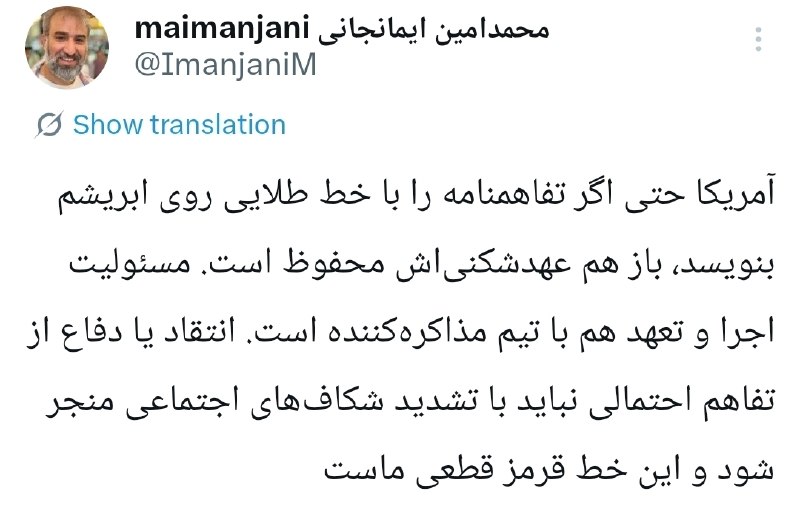
The 13 June 2026 commentary from Tasnim News — Tehran's English-language state-aligned wire — ran for a single short paragraph and a single, blunt idea. The United States, the piece argued, can write a memorandum on silk with a golden line and still walk away from it. The burden of enforcement, the author insisted, belongs to Iran's negotiating team, not to Washington's drafters.
Read literally, the line is rhetorical theatre — the kind of in-house signalling Iranian outlets often run in the days before a delegation flies to a Gulf hotel ballroom. Read structurally, it tells you almost everything worth knowing about why a US-Iran nuclear deal, if one lands at all in 2026, will arrive narrower, weaker, and more conditional than the diplomatic note-traffic implies.
The frame the wire is setting
The Tasnim framing is built on a specific grievance: that Washington treats signed documents as the start of a negotiation, not its conclusion. From Tehran's vantage, the 2015 Joint Comprehensive Plan of Action was the textbook case. The multilateral deal was signed, ratified via UN Security Council resolution 2231, and then progressively undermined by a US administration that withdrew in 2018 and reimposed sweeping sanctions under a "maximum pressure" doctrine. In Iranian elite memory, the lesson is that paper commitments from Washington carry an unusually short half-life, because domestic US politics — not Iranian behaviour — determines whether a deal is honoured in years three, four, and five.
That is the unspoken referent behind Tasnim's line about golden ink on silk. The piece is signalling, to a domestic audience, that any new memorandum is only as durable as the political coalition that signs it. The negotiating team — not the document — is the variable that matters.
What the commentary does not say — and why that matters
The Tasnim line is interesting precisely because of what it leaves out. It does not name a counterpart, does not cite a draft text, and does not commit Iran to a position. It also stops short of the regime's harder-line frame, which would flatly reject negotiations; instead, it accepts the premise of talks while poisoning the well around any outcome.
That posture is consistent with the pattern of recent Iranian public messaging during high-stakes negotiations. Public commentary at the state-aligned end of the spectrum tends to set a floor of demands — sanctions relief guarantees, verification sequencing, the fate of frozen assets — while leaving the negotiators space to settle for less in private. The Tasnim note performs the first half of that two-track play.
The structural point, stripped of rhetoric, is that Iran is operating in a market for commitments where the seller's currency has been depreciated by the buyer's own history. Tehran's negotiating team can sign anything; the question for Tehran is whether the document it signs comes with an enforcement mechanism Washington cannot unilaterally revoke.
The counter-narrative from Washington
The dominant Western wire framing treats the negotiations as a confidence-building exercise: both sides exchange concessions, sanctions relief arrives in tranches, and the International Atomic Energy Agency regaps the file. From that vantage, complaints about American unreliability are bargaining-position noise, the kind of rhetoric that hardliners on both sides deploy in print while diplomats do the work.
There is a fair amount of evidence behind that read. Iran's enrichment capacity has been substantially set back by Israeli and US strikes in 2024 and 2025, its regional proxy network is materially diminished, and its economy is operating under the kind of sanctions density that makes any deal — even a narrow one — materially valuable. In that context, Tehran has reasons to sign, not just reasons to distrust.
But the counter-narrative has its own limits. The Trump administration is operating with a sanctions architecture that can be tightened or eased by executive action, a Congress that has shown no appetite to constrain presidential discretion on Iran, and a regional alignment with Israel that the Iranian side reads as a built-in spoiler. From Tehran's side, the most plausible bad outcome is not that the talks fail — it is that the talks succeed, a deal is signed, and the deal is then legislatively or executively dismantled in Washington within a political cycle.
What that means for the next negotiating round
The practical implication is that any document emerging from the current track will likely be narrower in scope, more conditional in language, and more heavily sequenced in implementation than the public framing suggests. Sanctions relief will almost certainly be tied to verifiable steps, with phased release mechanisms rather than upfront concessions. Verification access for the IAEA will be the central technical fight. And the question of guarantees — what happens if a future US administration decides, as the 45th did, that the deal is no longer in the American interest — will sit unresolved at the bottom of the table, unaddressed but decisive.
For readers outside the negotiating room, the useful takeaway is that the most consequential document at the next round will not be the memorandum itself. It will be whatever side-text, side-letter, or political commitment Tehran extracts as the price of believing that this time, Washington's word will outlast the news cycle that produced it.
Desk note: Monexus frames this as an Iranian-elite signalling story, not a deal-or-no-deal forecast. The wire used here is a single state-aligned commentary; the analysis above triangulates from its framing against the public record of past US-Iran negotiations, including the JCPOA, US withdrawal in 2018, and the 2024–25 strikes on Iranian nuclear and proxy infrastructure. Where the Tasnim line and the Western wire line diverge, this publication has named the divergence rather than picking a side.
Wire provenance
This editorial synthesis draws on the following public wire/social posts:
- https://t.me/tasnimnews_en
- https://en.wikipedia.org/wiki/Joint_Comprehensive_Plan_of_Action
- https://en.wikipedia.org/wiki/United_Nations_Security_Council_resolution_2231
- https://en.wikipedia.org/wiki/International_Atomic_Energy_Agency