Irankunda's record goal powers Socceroos past Turkey in World Cup opener
A 20-year-old whose family fled to Tanzania before resettling in Adelaide became Australia's youngest ever World Cup goalscorer, opening a 2-0 upset of Turkey in Vancouver that announced a new generation of Socceroos.
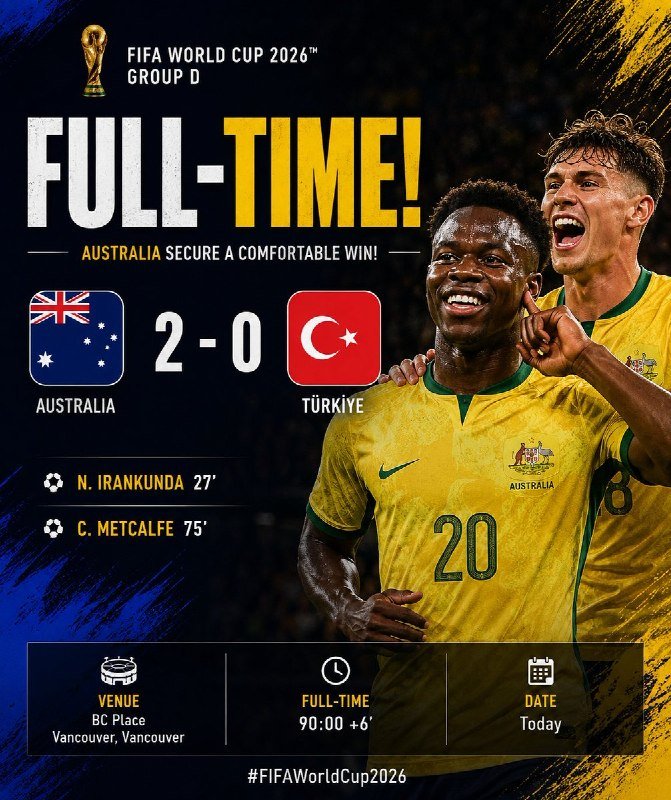
At 04:57 UTC on 14 June 2026, Nestory Irankunda ran onto a loose ball inside the Turkish penalty area in Vancouver and guided it past the goalkeeper. The strike made the 20-year-old the youngest Australian to score at a men's World Cup, headlining a 2-0 win over a Turkey side widely tipped to trouble the Group of Death. It also framed Australia's tournament around a forward who, only months ago, was deemed surplus to requirements at Bayern Munich.
The result is a statement of intent from a Socceroos squad in transition, and a reminder that the sport's centre of gravity is wider than the European leagues that shape its transfer market. Australia's opener doubled as a coming-out party for a cohort of players developed almost entirely outside the Premier League-Pipeline-to-England model — and it landed on the game's biggest stage.
A record built on reinvention
Irankunda's goal did not arrive in a vacuum. The Adelaide United product moved to Bayern Munich in 2024, signed as one of the most hyped teenagers in A-League history, then found first-team minutes scarce behind a depth chart built for the Bundesliga and Champions League. Reports through 2025 traced a loan to Grasshopper Club Zürich in the Swiss Super League, where he logged regular senior football for the first time in Europe.
His performance in Vancouver, on a stage his parent club rarely offers teenagers, underlined a pattern that has become harder to ignore: top-tier European academies continue to acquire talent from Australia's National Youth League and the A-League, but the developmental payoff now routinely accrues to the borrower, not the buyer. The Socceroos coaching staff appear to have reached the same conclusion that several Premier League and Bundesliga clubs are starting to formalise — that a 20-year-old who can deliver on a World Cup pitch is, by definition, ready.
The backstory runs deeper than a transfer decision. Irankunda was born in a refugee camp in Tanzania to parents who had fled Burundi, before the family resettled in Adelaide and enrolled their son in the local football pyramid. The symbolism of a Burundian-born, Tanzarian-raised, Australian-developed forward scoring the goal that broke Turkey's resistance is not lost on a federation that has spent two decades trying to broaden its talent base beyond the Anglo-Celtic heartland.
Turkey arrive as favourites and leave with questions
Vincenzo Montella's Turkey were, on paper, the more polished side. The Crescent-Stars arrived at the tournament with a qualifying record built on a deep midfield and a forward line that combined experience in the Italian and Spanish top flights. The pre-match odds reflected it.
What unfolded in Vancouver was different. Australia's press held its shape; the two goals came from transition moments that exploited the space behind Turkey's advancing full-backs. The second, in particular, was the kind of counter-attack that rewards defensive discipline and forward runners willing to commit early. Montella's side held territory in the second half but rarely tested the Australian goalkeeper with the kind of clear chance that turns a tournament opener.
Turkey's challenge now is mental as much as tactical. A loss to a side ranked outside the world's top 25 reframes a group that already includes a strong European opponent; the margin for error in the next two matches shrinks accordingly. For Australia, the inverse applies. A win of this profile — against a side expected to compete for the knockout rounds — gives Tony Popovic's squad permission to play with the composure the occasion demands.
A Socceroos reset, not a fluke
The temptation, after a single result, is to read too much into a tournament opener. Australia's history counsels caution: previous Socceroos squads have produced famous draws and upset wins in openers, only for the group stage to grind them down by matchday three.
The composition of this squad, however, is genuinely different. Of the starting XI in Vancouver, a majority were aged 25 or under, and the side that finished the match featured two further substitutions drawn from the same cohort. Football Australia's investment in the European loan circuit — placing young players at Swiss, Belgian, and Dutch clubs where the pathway to minutes is shorter than at Premier League giants — is beginning to compound. The structural bet is that a generation of players schooled in first-team football abroad, rather than the second XI of an English academy, will mature into a coherent national-team spine by the 2030 cycle.
The economic backdrop matters too. The A-League's broadcast deal remains modest by global standards, and the Socceroos cannot match the salary base of the European leagues their best young players now enter. What the federation can offer is something the market is starting to price in: a credible national-team project, a clear developmental pathway from the A-League to senior caps, and — as of 04:57 UTC on 14 June 2026 — a World Cup goalscoring record that belongs to a 20-year-old with a backstory no scouting database would have predicted.
Stakes beyond the group
Australia's next two fixtures, against a pair of higher-ranked opponents, will determine whether the Vancouver result becomes a tournament footnote or a foundation. The structural stakes extend further. A deep run would validate the loan-and-develop model that Football Australia has quietly built over the past four years; an early exit would not invalidate the model but would, in the brutal arithmetic of football politics, give ammunition to those who argue that the path to relevance still runs through the big-five European leagues.
For Irankunda personally, the goal is a clarifying moment. A player who left Adelaide as a teenager and who, eighteen months ago, was not in Bayern's first-team picture, has now scored at a World Cup. The transfer market tends to be unforgiving to players whose value depends on potential. As of this week, that calculation has changed.
What remains genuinely uncertain is Turkey's response. A side of their experience rarely folds after a single group defeat, and Montella has been here before. The next 72 hours — training, selection, the opponent's shape — will tell us more about the tournament's likely knockout field than this opening 90 minutes.
How Monexus framed this: a sports desk led with the human story of a refugee-background record-breaker and the structural shift in Australian player development, rather than the upset-result frame that dominated wire headlines. Both reads are accurate; the structural one will track whether this is a one-off or a step-change.