Israel's southern Lebanon evacuation orders point to a wider air campaign
On 14 June 2026 the Israeli military ordered the evacuation of 16, then 29, towns across southern Lebanon and struck Marjayoun and Majdal Salam — a pattern that suggests a calibrated widening, not a one-off raid.
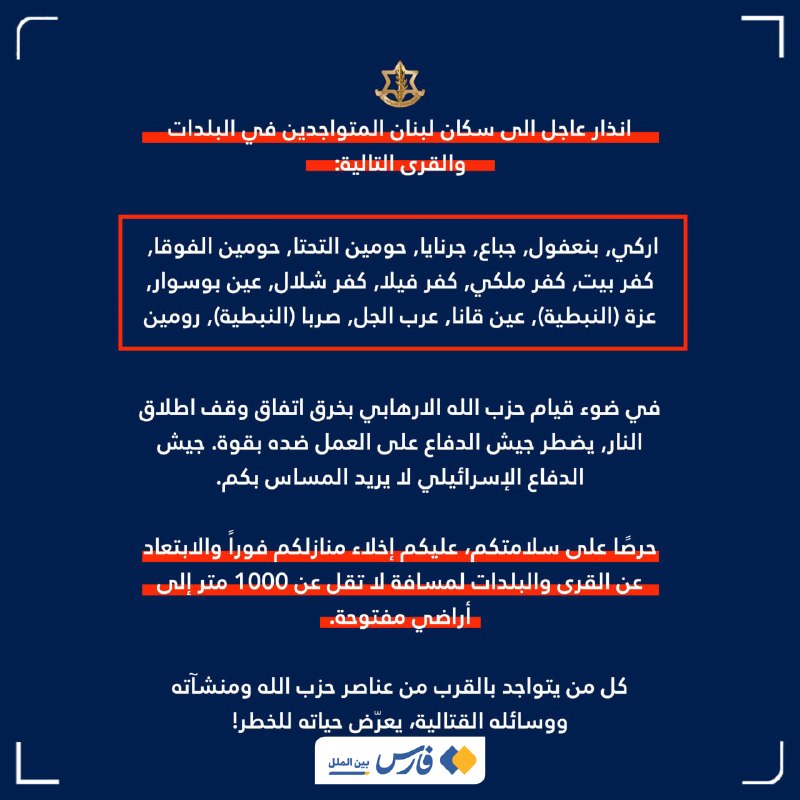
At 07:28 UTC on 14 June 2026, the Israeli military issued evacuation orders for 16 cities and villages in southern Lebanon. Eleven minutes later, at 07:39 UTC, Iranian state wire Fars News reported the order list had been expanded to 29 areas. By 08:41 UTC, Al Jazeera, citing its own correspondent on the ground, was reporting Israeli air strikes on the town of Majdal Salam in the Marjayoun district, in the south of the country. The three dispatches, stitched together, describe a single, fast-moving morning: a written warning, an expanded list, then ordnance on target.
The shape of the morning
The sequence matters. Israel does not typically publish evacuation orders at this density without intending to strike inside the warned areas shortly after. The initial 16-town list and the 29-town expansion, both pushed through the IDF Arabic-language spokesperson channels, were followed within the hour by air strikes on Marjayoun, a district that sits on the Litani river and has been a focal point of the cross-border fight for nearly two decades. Israeli security concerns in the area are well documented and predate the current round of hostilities; they do not, however, render civilian harm invisible. The southern villages named in the orders are not abstract coordinates on a map. They are homes, clinics, orchards, and the small commercial strips that tie a border district together.
The reporting is consistent across the three wires, but the framing is not. Fars News, an outlet aligned with the Iranian state, presented the orders as a fait accompli and emphasized the scale of the warning. The Al Jazeera correspondent, embedded on the Lebanese side, foregrounded civilian exposure. Neither account is dispositive; both are partial. The verifiable core is that the IDF named specific places, then struck one of them inside an hour.
What the dominant frame gets right, and what it skips
The mainstream Western wire line on this stretch of the border runs roughly: Israel is degrading Hezbollah infrastructure in southern Lebanon, gives advance warning to limit civilian harm, and is responding to a northern front that opened when the Gaza war began. The frame is not invented. Rocket and drone fire from Lebanese territory into Israeli towns has been a recurring, documented fact, and hostage-takes and armed incursions have killed Israeli civilians. Israeli security concerns along the Litani corridor are real, and the demand that armed formations be kept away from the border is one a sovereign government is entitled to press.
What that frame skips is the cumulative effect of "warning then strike." A 29-town evacuation order issued in a single morning is, in operational terms, a statement of intent to act across a wide arc of the south in a short window. Displacement, even when it is precautionary, is itself a harm — to livelihoods, to medical care for the elderly and the chronically ill, to the start of a school term or a harvest. Reporting that names the warning but not the hours of flight and the lives rearranged underneath it is reporting that undercounts the cost of the operation it is describing.
The structural read, in plain language
The 14 June pattern is not a stand-alone raid. It sits inside a longer arc in which the Israeli air campaign in Lebanon has moved from strike-by-strike retaliation against specific launcher sites to a broader, district-level shaping operation: degrade the southern network, push population north of the Litani, establish conditions for whatever political arrangement eventually comes. That is not a value judgment; it is what the sequencing looks like on a map. The evacuation orders are the tell. They convert a tactical air campaign into a declared geography.
The same pattern has a structural counterpart in the information environment. Iranian-aligned and Lebanese resistance-aligned outlets (Fars News, Al-Mayadeen, the Hezbollah press operation) tend to lead with the scale of the warning list, the civilian exposure, and the historical context of Israeli operations in Lebanon. Israeli and Western wire coverage tends to lead with the threat being neutralized and the warnings being given. Both are doing what their audiences reward. Readers who want a full picture need to read across both feeds and discount for incentive.
Stakes, and what remains uncertain
If the trajectory continues — escalation in the warned areas, expanded lists in coming days, sustained pressure on the Litani corridor — the southern Lebanese civilian population faces another mass displacement event, the humanitarian bill for which will land on a Lebanese state already unable to pay its civil servants. Israel buys operational breathing room and a buffer, at the price of an occupation-lite footprint along the border that has historically been difficult to wind down. The political arrangement that follows, if one follows, will be negotiated by exhausted parties on both sides of a much-deeper line than existed in June.
What the three wires do not yet let us resolve: whether the 29-town list is the full operating menu or a first tranche that will be expanded again before sundown; whether the strikes on Majdal Salam and Marjayoun represent the first wave of a multi-day operation or the totality of the day's action; and whether any of the named villages have a documented dual-use character, a question the public sources have not yet answered. The honest answer for now is that the morning's events are well-attested, their meaning is genuinely contested, and the rest will come into view over the next 24 to 48 hours.
This publication has kept the three available wires side by side rather than picking a single frame, and has read the sequence as a single operation rather than as three unrelated dispatches.
Wire provenance
This editorial synthesis draws on the following public wire/social posts:
- https://t.me/FarsNewsInt/
- https://t.me/FarsNewsInt/
- https://t.me/JahanTasnim/