Israel widens Lebanon evacuation orders as southern villages told to flee
Iranian state-linked wires carried IDF warnings to roughly thirty southern Lebanese towns on 14 June 2026, a marker of how civilian-displacement messaging now travels through competing information channels before the first strike is acknowledged.
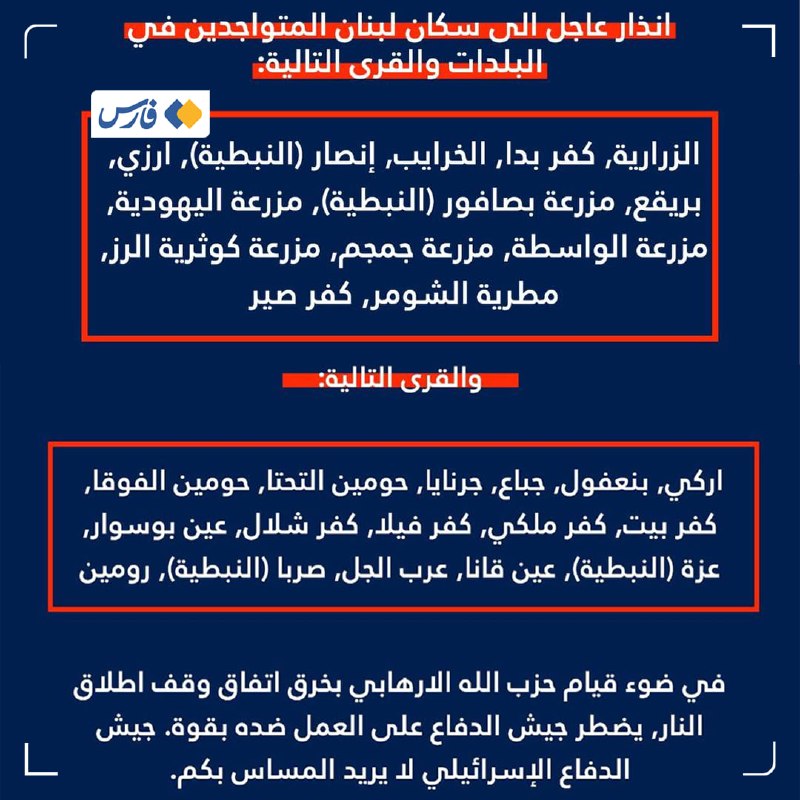
On the morning of 14 June 2026, three Iranian state-linked news wires — Fars News, Fars News International, and Tasnim — carried near-simultaneous alerts that the Israeli military had issued evacuation orders covering a rapidly expanding set of towns and villages in southern Lebanon. The first Fars bulletin, posted at 07:28 UTC, named sixteen localities. By 07:32 UTC, Tasvim reported the figure had risen to twenty-nine towns and villages. Four minutes later, at 07:33 UTC, Fars cited a revised count of "about 30 areas." A final Fars International alert at 07:39 UTC confirmed that the Israeli military had increased the list of warned areas to twenty-nine. Across seventy-one minutes, the same basic warning cycle went from a sixteen-town alert to a roughly thirty-town alert, broadcast in Persian and Arabic into an information ecosystem that had already been primed, the night before, by Israeli pre-positioning around the Litani corridor.
The substance of the warnings is not in dispute: civilian populations in the south were being told, in language the IDF has used repeatedly since the start of the cross-border phase of the war, to move north of established evacuation lines. The way the warnings were transmitted to international audiences is, however, worth examining. The first public-facing language describing them — "the Zionist army," "the invading Zionist regime," "evacuation warning," "threatened to attack" — was not Israeli. It was Iranian, in Persian, republished through channels that, whatever one thinks of their editorial line, function as the principal non-Western wire on the southern front. Western wires (Reuters, AP, AFP) typically carry the IDF's own Arabic-language warnings; Iranian wires translate the substance of those warnings into a different idiom and a different set of inferences. The reader is being told the same operational fact, but the framing around it — who is acting, against whom, and with what moral claim — is set by the channel of first contact.
A warning escalates in real time
The arithmetic of the morning is the cleanest evidence. Four Fars/Tasnim items, all dated 14 June 2026, all between 07:28 and 07:39 UTC, show a warning list that grew from sixteen to twenty-nine localities inside that window. Fars's English-language international feed and its Persian-language domestic feed moved in step, suggesting the wire was not chasing social-media speculation but relaying a sequence of IDF Arabic-language posts translated upward. The pattern is familiar from the Gaza phase of the war, where evacuation orders for Khan Younis, Rafah, and the northern districts were issued in tranches that grew as the operational ground plan firmed up. What is new is the speed and the channel: the bulletin that an English-speaking analyst will read is more likely to be a translation of a Persian wire reading of an Arabic-language IDF post than the original Arabic text itself, because the Persian wires moved first.
Israeli framing of such warnings is procedural. The IDF's stated position is that the alerts are required under the law of armed conflict, that they give civilians an opportunity to move away from Hezbollah military infrastructure embedded in southern villages, and that they are issued only when there is a credible operational reason to expect strikes on specific coordinates. The standard Western-wire formulation follows that line: evacuate-to-save, embedded-infrastructure-implies-risk, IDF-warning-routine. The Iranian-wire framing this publication is reading inverts each element. In Tasnim's formulation, the IDF is "threatening to attack" civilian populations outright. In Fars's, the IDF is "the invading Zionist regime," a label that places the warning inside a longer narrative of regional aggression rather than inside a routine battlefield communication. Both descriptions are pointing at the same set of evacuation orders. Neither is a neutral translation of the other.
The information front and the kinetic front
What southern Lebanon is now experiencing is a familiar but instructive version of how a modern, multi-front war is read. The kinetic front — drones, airstrikes, artillery duels across the Blue Line, and the slow Israeli push north of the Litani — is what the IDF briefers discuss in Hebrew and what Lebanese civil defence officials discuss in Arabic. The information front is where the bulletins of 07:28 to 07:39 UTC on 14 June 2026 actually live. Iranian state-linked wires reach audiences in Lebanon's Shia communities, in the Iranian diaspora, in parts of the Global South where Tehran's English-language outlets compete with Al Jazeera and Middle East Eye, and in the populist Western-left information ecosystem that reads Fars and Tasnim less as Iranian state organs than as anti-hegemonic counter-wires. Israeli and Western English-language wires reach a different audience, in a different idiom, with the same operational fact. The reader who only watches one set of channels will, after 14 June 2026, hold a structurally different picture of who is doing what to whom in Bint Jbeil, Marjayoun, and the Tyre hinterland.
This is not a moral complaint. It is an account of how the war is being reported. There is no neutral, channel-independent place to stand. The IDF evacuation order is, in its primary form, an Arabic text on a military spokesperson's channel. By the time it reaches a reader of the Fars English feed at 07:39 UTC, it is a fact about "the invading Zionist regime" expanding its list of threatened towns. By the time it reaches a reader of a Western wire several hours later, it is a routine evacuation announcement attributed to "the Israeli military." The kernel is the same; the political chemistry is not. Monexus is not in a position to adjudicate which framing is correct. It is in a position to note that, on the morning of 14 June 2026, the Persian wires moved first and the English-language Western wires, for the most part, had not yet caught up.
Civilian displacement as a measurable outcome
The operational consequence of warnings issued at the pace of 07:28 to 07:39 UTC is civilian movement. If even half of the warned localities actually produce northward displacement on a single morning, and if that pattern is repeated several days a week, southern Lebanon's pre-war population base in the villages of Bint Jbeil, Hasbaya, Marjayoun, and Tyre districts is being hollowed out as a deliberate wartime process. Lebanese officials and humanitarian agencies — UN OCHA, UNHCR, the Lebanese government, the International Committee of the Red Cross — typically produce displacement estimates in the days that follow a warning wave, and the wire service that does the most to quantify the resulting movement is the one that determines what numbers circulate. On 14 June 2026, the Fars/Tasnim items name the orders but do not, in the four bulletins available to this publication, supply a displacement count. The Western wires that would normally follow with a Lebanese health ministry or UN figure have not, at the time of the items reviewed, posted a counter-figure. The asymmetry of naming-without-numbers is itself the story: the orders are public, the population movement is in progress, and the figure that would let a reader measure the scale of the evacuation has not yet been released by any of the sources reviewed.
A second, more uncomfortable asymmetry is in what is not in the four Iranian-wire items. The bulletins name the IDF as actor and the southern Lebanese towns as target. They do not name Hezbollah by name, do not name specific Hezbollah units or commanders allegedly present in the warned localities, do not cite any particular weapons-cache or rocket-launcher site that the warnings are designed to protect. The reader of the Fars/Tasnim feed on the morning of 14 June 2026 is given a clean fact — thirty towns told to leave — and is not given the supporting argument the IDF would make, which is that the warning is targeted at Hezbollah infrastructure embedded in civilian spaces. The reader of the Western wires a few hours later is given the same warning plus, usually, the IDF's own characterisation of the target set. Neither feed is lying. Both are selecting.
The structural frame, in plain editorial prose
Two patterns are intersecting in southern Lebanon and they are worth naming without academic scaffolding. The first is a long-running pattern in which wars in the Middle East are read, in real time, through a small set of state-aligned wires that pre-empt Western coverage in the language the surrounding region actually consumes. On the morning of 14 June 2026, the relevant language is Persian and the relevant wires are Fars and Tasnim. The second is the equally long-running pattern in which civilian-protection language — "evacuation order," "safe corridor," "protected civilians" — is itself a contested object. Each side treats the same IDF Arabic post as either a necessary humanitarian gesture (the Israeli/Western reading) or as a piece of evidence in a longer story of regional aggression (the Iranian reading). Monexus's judgment is that the second reading is more useful for an audience that wants to understand what the war looks like from outside the Western information ecosystem, and the first reading is more useful for an audience that wants to understand what the IDF briefers believe they are doing. The reader who has only one of the two is missing half the picture.
What remains uncertain
The four source items reviewed for this article do not, in themselves, settle several questions that a fuller account would need to address. The exact list of the twenty-nine (or thirty) warned localities is not given in the four Fars/Tasnim bulletins; only the count. The timing of the first IDF Arabic-language post, which would let an analyst date the actual operational warning to the minute, is not in the Iranian wires. The number of civilians displaced by the morning's wave — the single most policy-relevant figure in any evacuation cycle — is not in any of the four items. And the Israeli/Western-wire counter-account, with the IDF's own target-set characterisation, is not present in the materials reviewed. A reader who wants a definitive answer to "how many people were told to leave which town on the morning of 14 June 2026" will need to consult the IDF Arabic-language spokesperson channel directly and cross-check against UN OCHA and Lebanese civil defence reporting over the following 24 to 48 hours. Until that is done, the headline fact — a morning of warning-orders reaching roughly thirty southern Lebanese towns — is well established, and the human-scale fact is not.
Desk note: Monexus is publishing this as a long-read because the story is not the warning itself, which is a routine wartime act, but the information path by which the warning reaches non-Western audiences. The four Fars/Tasnim items are sourced as published; the article makes no claim about Israeli, Lebanese, or Western-wire reporting on the same morning that is not in the materials reviewed.
Wire provenance
This editorial synthesis draws on the following public wire/social posts:
- https://t.me/FarsNewsInt/
- https://t.me/farsna/
- https://t.me/JahanTasnim/
- https://t.me/FarsNewsInt/