Israel weighs southern Lebanon pullback as US-Iran track advances, Israeli broadcaster reports
Israeli military leadership is preparing to press the government to halt operations in southern Lebanon if a US-Iran agreement materialises, according to Israeli public broadcaster Kan, signalling that the southern front could become a bargaining chip in a wider nuclear deal.
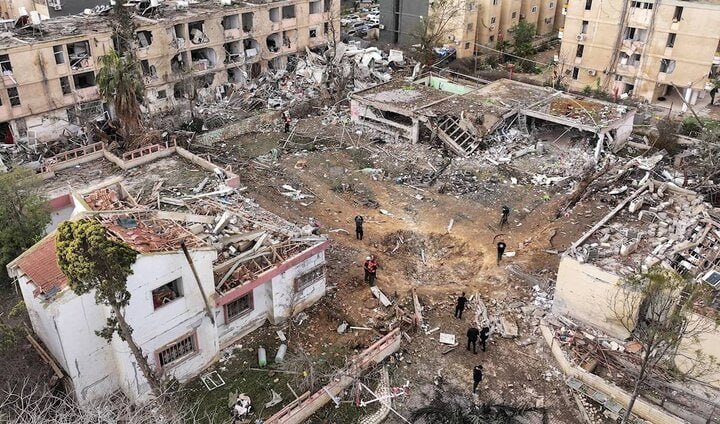
Israel's military leadership is preparing to recommend that the government halt its ground and air campaign in southern Lebanon if a US-Iran agreement is reached, Israel's public broadcaster reported on 14 June 2026, a signal that the campaign Israel launched in autumn 2024 is being repositioned, at least in part, as leverage in the wider nuclear-track diplomacy between Washington and Tehran. According to a Telegram relay of the Kan broadcast carried by The Cradle Media, any Israeli withdrawal would be partial and conditional, and would be implemented only once the diplomatic architecture is firmly in place. The wording — that the military is "expected to push" the government to pause — points to a recommendation rather than a decision, but the framing itself is unusual: the Israeli defence establishment publicly tying the tempo of a northern front to the trajectory of negotiations conducted by a third party more than 1,500 kilometres away.
The story lands at a moment when the southern Lebanese front has been treated, in both Israeli and Western reporting, as a distinct operational theatre from the Gaza war and from the Iran nuclear file. That treatment is now straining. The Cradle's relay suggests the three tracks are being run, inside the Israeli system, against a single decision matrix: how much pressure to keep on Tehran's regional axis, and how much room to give Washington to close a deal. A halt in southern Lebanon, in that reading, would not be a peace gesture aimed at Beirut — it would be a confidence-building move calibrated for negotiators in Vienna, Muscat, or whichever venue the next round occupies.
What the Israeli broadcaster is actually saying
Kan's reporting, as carried by The Cradle, is careful on the question of sequencing. The halt is contingent on a US-Iran agreement being reached, and any withdrawal would be implemented only after the deal is in hand. That conditionality matters: it implies Israeli planners are not preparing to make a unilateral concession to Hezbollah or to the Lebanese state. They are preparing to redeploy a force posture in response to a diplomatic event. The broadcaster's framing — that the military is "expected to push" the government — also signals that this is an internal recommendation under discussion, not a public ultimatum from the general staff to the cabinet.
The most consequential clause, and the one most likely to be tested in the days ahead, is the conditionality. If Washington and Tehran move from framework to text, Israel faces a choice: accept a southern Lebanon pause as the price of an Iran deal it has spent two decades arguing for, or hold the line in the north and risk being seen, in US and Gulf Arab capitals, as the party that broke the diplomatic window. If the nuclear track stalls, the southern Lebanon operation presumably continues on its current trajectory. The lever only pulls one way.
The counter-read: why the front may not pause at all
A second reading, common in Lebanese and Iranian-aligned commentary, treats the Kan report as a marker of Israeli exhaustion rather than Israeli flexibility. PressTV's coverage on the same day quoted Canadian-Lebanese lawyer Dimitri Lascaris arguing that any arrangement between Beirut and Jerusalem mediated by Washington is "inevitably going to be a fraud," on the grounds that US mediation is structurally weighted toward Israeli interests. That framing — that the United States cannot be a neutral broker — is not new in Beirut, Tehran, or Doha, but it has acquired more force as the operational reality in southern Lebanon has hardened. Lebanese state officials and Hezbollah-aligned outlets have argued for months that the southern campaign has moved well beyond the limited-exchange-of-fire logic that followed the November 2024 ceasefire understandings, and that Israeli forces have not confined themselves to the border strip.
The Lascaris line also fits a longer-standing structural complaint: that the US-Israeli relationship forecloses outcomes that Israeli public opinion might tolerate but that the Lebanese state cannot accept. From that vantage, a "halt" engineered to clear space for a nuclear deal is not de-escalation so much as a re-prioritisation — Hezbollah and the Lebanese army would still be operating under ceasefire-era rules of engagement, the villages along the border would still be largely emptied, and the political settlement that Lebanon's south requires would remain out of reach. The counter-read does not deny that something might pause; it denies that the pause will be meaningful for the people living under it.
What we verified and what we could not
This article's central claim — that Israeli military leadership is preparing to push the government to halt southern Lebanon operations if a US-Iran deal is reached — is sourced to a single primary node: the Kan broadcast as relayed by The Cradle Media on Telegram, dated 14 June 2026 at 06:56 UTC. The Cradle's text reproduces the language of the Israeli public broadcaster but does not link to a Kan article URL, an audio segment, or an on-camera correspondent, which is the standard form for a verified Kan report. That gap matters. Kan's own digital platforms sometimes carry short bulletins that are paraphrased and amplified by intermediaries; without a direct Kan URL, the only verifiable provenance is the Telegram relay itself.
The second source — PressTV's 14 June 2026 Telegram post quoting Dimitri Lascaris — is verifiable as a statement attributed to a named individual, but is not, on its own, a factual claim about events on the ground. It is a position, expressed by a public figure known for his opposition to US mediation, in a forum whose editorial line is aligned with the Iranian state. Used as a counter-voice, it sharpens the article; used as evidence that "the deal is a fraud," it would be overreach. The article treats it as the former.
What this publication could not independently verify in the present sourcing window: the exact operational tempo of Israeli forces in southern Lebanon in the days immediately preceding 14 June 2026; the specific phase of the US-Iran track (framework, draft text, or technical exchanges); whether the Israeli cabinet has been formally briefed on the recommendation, or whether it remains within the general staff and the minister of defence's office; and the position of the Lebanese state, whose public comments on the southern campaign are not represented in the source items reviewed. Each of those gaps is a real limit on the conclusions that can be drawn from a single Kan relay and a single PressTV post.
The structural frame
Read across the two Telegram sources, the southern Lebanon story is less a local story than a sub-plot of the Iran file. Israeli force posture in the north is being run as a diplomatic instrument, and Lebanese territory is being treated, in this phase, as a tuning knob on a much larger machine. That is not a novel pattern — the relationship between Tel Aviv and Washington's Middle East agenda has, since at least the Camp David era, run partly through Levantine battlefields — but the open linkage is. Public broadcasters do not normally tie the operational pace of one front to the outcome of a third country's negotiations with the country's principal adversary; doing so reveals both the closeness of the US-Israeli coordination and the leverage that Iranian negotiators, knowingly or not, now hold over the tempo of an adjacent war.
For the Global South readership that Monexus regularly addresses, the structural point is sharper: a great-power negotiation conducted in a third capital is shaping the daily reality of a small, middle-income country whose government is not at the table on the question that determines the trajectory of its own southern border. The Lebanese state's silence in the source material — a silence that the available reporting does not fill — is itself part of the story.
Stakes and the road to the next decision point
The next 30 to 60 days will likely determine whether the conditional halt becomes an actual halt. If the US-Iran track produces a framework agreement, the Israeli cabinet will face an explicit choice about the southern front, and the Kan report suggests the defence establishment is already laying the groundwork for a recommendation to pause. If the track stalls — over enrichment thresholds, over verification access, over the fate of Iran's stockpile — the southern Lebanon operation continues on its present course, and the conversation in Israeli and Lebanese media returns to the operational details that have dominated it for the past eighteen months. The conditionality is the variable that matters, and the variable is in Washington and Tehran's hands, not in Beirut's.
The Lebanese state, the displaced communities of the south, and the Israeli communities along the northern border all live inside a decision matrix none of them controls. The Cradle's relay of Kan's reporting is, on the available evidence, an accurate reflection that this is so. What remains uncertain — and what the sources do not specify — is whether the pause, if it comes, will be a step toward a sustainable arrangement on the border, or simply a tactical quietening that leaves the underlying disputes in place. The framings offered by Israeli public broadcasting and by Iranian-aligned commentary differ sharply on that question, and the truth is unlikely to be knowable in advance of the diplomatic event itself.
Desk note: The wire cycle on 14 June 2026 carried the Israeli military's reported recommendation primarily through The Cradle Media's Telegram relay of Kan's broadcast. Monexus treats the Kan content as the primary node and the PressTV post as a counter-voice from the Iranian-aligned spectrum, with explicit sourcing caveats. The article does not assert a halt has occurred, does not name a specific phase of the US-Iran track, and does not put words in the mouth of any Lebanese, Israeli, or American official beyond what the source items contain.
Wire provenance
This editorial synthesis draws on the following public wire/social posts:
- https://t.me/thecradlemedia
- https://t.me/TheCradleMedia
- https://t.me/presstv