Southern Lebanon bears the weight of a familiar calculus: Israeli strikes hit Tyre district villages
Israeli airstrikes hit Majdal Zoun, Al-Mansouri and Qlaileh in Lebanon's Tyre district in the early hours of 14 June, the latest escalation in a months-long exchange that has flattened villages and displaced civilians along the frontier.
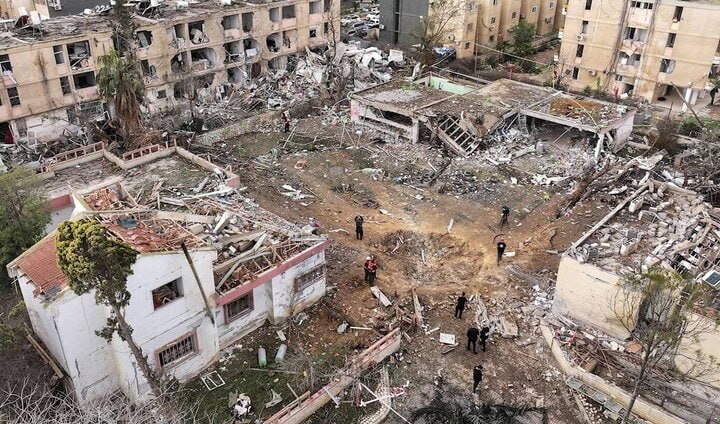
Israeli warplanes struck multiple villages in Lebanon's Tyre district in the early hours of 14 June 2026, hitting the outskirts of Majdal Zoun, Al-Mansouri and Qlaileh following a night of heavy ground-level battles in Majdal Zoun, according to regional outlets monitoring the frontier. The strikes, reported at 06:24 UTC by The Cradle's Telegram channel and independently confirmed in initial accounts by Al-Alam Arabic, are the latest in a months-long cycle of cross-border fire that has hollowed out a string of Tyre-district villages and pushed civilian life closer to the Mediterranean shoreline.
The pattern is now established: Israeli sorties in the south, retaliatory rocket and drone volleys north across the border, diplomatic cables shuttling through Cairo and Washington, and a ceasefire that holds for weeks or months before the next breakdown. What changes from round to round is the geography of the strikes and the small print of the mediating agreement. On 14 June, the geography was the Tyre district's southern villages, the same arc of terrain that has absorbed the bulk of Israeli firepower since the war in Gaza began in October 2023.
A night of battles, a morning of bombs
The Cradle's reporting, carried on its Telegram channel at 06:24 UTC, described overnight clashes in Majdal Zoun before dawn airstrikes hit the same village, Al-Mansouri and Qlaileh. Al-Alam Arabic, an Iran-aligned satellite outlet that has covered the south throughout the conflict, posted a corroborating alert at 05:49 UTC noting that "the occupation" — its standard editorial shorthand for Israel — had struck the outskirts of Majdal Zoun and Al-Mansouri. The convergence of two separate feeds within a 35-minute window is a strong signal that the strikes were real and broadly as described, though both outlets take a clear editorial line against Israel and the framing of specific casualty figures should be treated with caution.
For Tyre-district residents, the topography of the attacks matters more than the timing. The three named villages sit on a coastal strip south of the Litani River, the line that United Nations Security Council Resolution 1701 of 2006 was supposed to keep clear of armed non-state forces. The resolution's implementation has been contested for two decades; in practice, the Israeli air force has treated the area as a standing target since the start of the current Gaza war, and ground clashes have multiplied since the November 2024 ceasefire between Israel and Hezbollah collapsed in stages through 2025.
The Cradle's brief noted "a night of heavy battles in Majdal Zoun," a phrase that implies close-quarters engagements rather than airstrikes alone. Independent wire reports, which would normally specify whether infantry, armour or airstrikes were involved, are not yet available in the thread context Monexus is reading from. The picture is therefore consistent with a familiar operational sequence: Hezbollah-aligned cells fire anti-tank missiles or rocket-propelled grenades at Israeli troops or their allied militia positions; Israel responds with artillery and air power; and the villages in between take the damage.
Israeli security concerns, plainly stated
The Israeli security establishment's framing of the southern Lebanon front is straightforward and worth stating on its own terms. The northern districts of Israel — including the Galilee panhandle and the Upper Galilee — have been subject to rocket, anti-tank and drone attack from south Lebanon since 8 October 2023, the day after the Hamas assault that triggered the Gaza war. The Israeli government's position is that Hezbollah — the dominant armed force in the area — has used the Tyre district as a launch pad, and that the IDF's campaign is aimed at pushing the group north of the Litani and degrading its precision-rocket and drone capabilities. That position is the stated one in Israeli press briefings, in UN reports by the secretary-general on Resolution 1701, and in the U.S. and French mediation efforts that have produced successive truces.
The counter-position, equally plainly stated, is the one carried by The Cradle, by Al-Alam Arabic, and by the Lebanese state's own diplomatic channels: that the strikes are disproportionate, that they are hitting civilian infrastructure in a country that did not start the war, and that Israel's reading of its security perimeter effectively legalises a standing bombing campaign over Lebanese villages. Both readings rest on established facts; they differ on which facts are weightier.
The structural picture
What is being executed in the Tyre district, in plain language, is a frontier pacification operation under sustained air cover. Israel treats the strip between the border and the Litani as a buffer zone, contested continuously rather than occupied outright. Hezbollah, weakened by the killing of much of its senior cadre in 2024 and by the broader collapse of Iran's regional posture, retains the ability to harass but not to hold. The result is a slow-bleed conflict that does not produce the kind of decisive operation that ends a war, only a sequence of strikes, counter-strikes and mediated pauses that gradually reduce the inhabited surface of the Tyre district's south.
The diplomatic track has not produced a stable equilibrium. Reports over recent months — carried by mainstream wires and tracked in this publication's wider reading — point to a Qatari-Egyptian-American-French quartet attempting to keep a framework deal alive. The framework, in its public outlines, calls for Hezbollah to withdraw north of the Litani, an international monitoring presence on the river, and a phased Israeli pullback. The framework has held on paper and not on the ground. The 14 June strikes are exactly the kind of event that erodes what remains of it.
What is not yet in the record
Monexus's reporting at this hour rests on two regional outlets, both of which carry a clear editorial line, and on a single operational picture: a handful of named villages, an overnight battle report, and a morning of airstrikes. Independent wire confirmation of casualty figures, of which specific Israeli units or formations are engaged, and of whether the strikes were directed at Hezbollah infrastructure, civilian sites, or both, is not in the thread context. The Cradle's reporting should be read as the outlet's account, not as a consensus wire report; Al-Alam Arabic, similarly, is Iran-aligned and treats Israeli military action editorially. The convergence of the two, on the basic fact of the strikes, is the strongest signal available at 06:30 UTC on 14 June 2026; everything else — numbers, targets, civilian or military status — should be treated as preliminary.
The pattern, however, is the part that matters most. Tyre district's southern villages have been struck repeatedly over the past 30 months. The diplomatic language around a ceasefire has been quiet for some weeks. The next round of talks, if it materialises, will likely begin from a worse starting position than the one before it. Until then, Majdal Zoun, Al-Mansouri and Qlaileh are the names on the map; the civilians who live in them are the ones the pattern lands on.
This article was produced from two regional Telegram feeds; the wire confirmation of casualty figures and specific target details is pending. Monexus will update when independent reporting is available.
Wire provenance
This editorial synthesis draws on the following public wire/social posts:
- https://t.me/thecradlemedia
- https://t.me/alalamarabic
- https://en.wikipedia.org/wiki/Tyre_District
- https://en.wikipedia.org/wiki/United_Nations_Security_Council_Resolution_1701
- https://en.wikipedia.org/wiki/Litani_River
- https://en.wikipedia.org/wiki/2023%E2%80%932024_Israel%E2%80%93Hezbollah_conflict