Evacuation orders and the geometry of southern Lebanon: 29 towns, one warning cycle
Iran-aligned outlets carried a single Israeli evacuation warning through the morning of 14 June 2026 — first 16 localities, then 29. The escalation is in the number, not the language.
The shape of a single morning
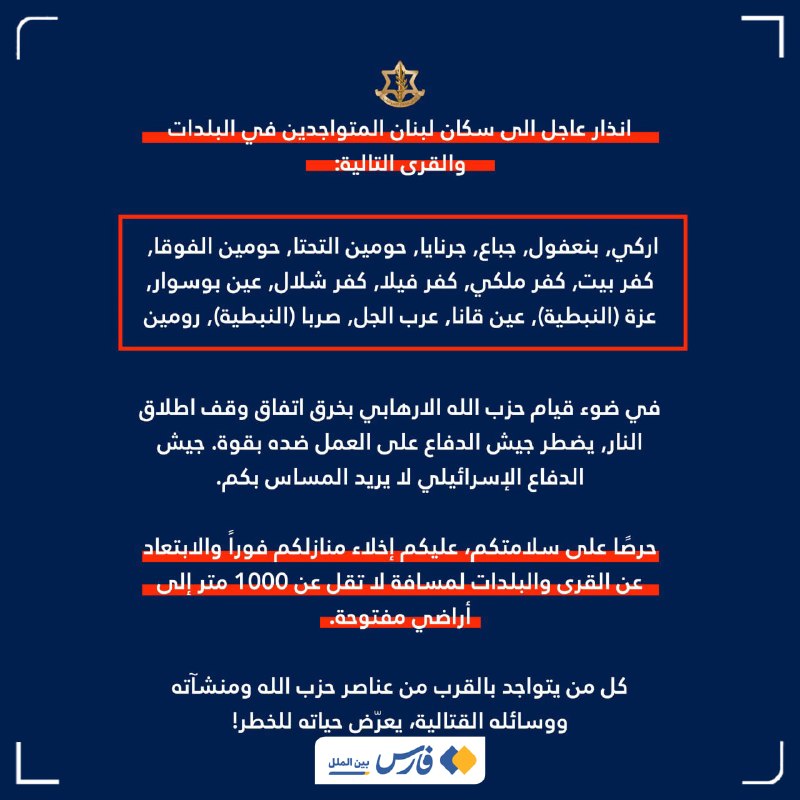
At 07:28 UTC on 14 June 2026, Fars News International flashed a red banner across its English-language Telegram channel: the Israeli army had issued an evacuation order for sixteen cities and villages in Lebanon. Twenty-three minutes later, at 07:51 UTC, Tasnim News — the English desk of Iran's state-aligned outlet — carried the same story with a higher number. Twenty-nine towns and villages in southern Lebanon had been told, by the army of what Tasnim called the "invading Zionist regime," to leave. Fars updated its count in parallel. By the end of the cycle, three Iranian state-adjacent channels — Tasnim in two postings, Fars in two more, and Tasnim's Persian-language Jahan Tasnim mirror — were carrying a single, agreed-upon claim: the evacuation list had nearly doubled in under half an hour.
The figure is the news. The architecture of the warning is the story.
What the morning's wire actually said
The source material is narrow. Four Telegram posts from three distinct channels, all posted inside a twenty-three-minute window, all Iran-aligned, all referencing the same Israeli army communication. There is no Reuters confirmation in the source set, no AFP wire, no IDF Spokesperson's English-language post, no UN OCHA flash update, no L'Orient Today bulletin. The thread records what the Iranian press said Israel had said, and the trail stops there. Fars and Tasnim agree on the trajectory of the warning: sixteen localities first, twenty-nine within minutes. They agree on the geography: southern Lebanon. They agree on the actor: the Israeli army, characterised in their framing as an occupying force threatening civilians.
What they do not record — and what a reader cannot therefore verify from this thread — is the list itself. No town names appear in any of the four posts. No timestamps of the original Israeli announcement. No operational justification. No casualty figure, no map reference, no link to a primary Israeli military statement. The warnings as transmitted are pure geometry: a count, rising in real time, attached to no specific place.
That geometry is itself informative. It tells the reader that the Iranian state-aligned press was reading the same underlying communication and refreshing its copy live, rather than operating from a pre-prepared narrative package. It also tells the reader that the Israeli communication itself, whatever its original form, was structured in a way that lent itself to a running tally — new localities appended, old ones presumably confirmed, the curve of escalation visible in the cadence of the updates.
The counter-narrative the wire does not carry
The Israeli framing of mass evacuation warnings in southern Lebanon is functional, not punitive. They are, in the standard Israeli military doctrine applied in Gaza and in earlier Lebanon operations, an attempt to separate civilian population from anticipated strike zones — a process the IDF has publicly defended in international fora, and one that Israeli legal advisors have argued satisfies the proportionality and distinction requirements of the law of armed conflict. The warnings are not a threat against civilians; they are a warning that military action is coming, with the implicit instruction to move. Whether that doctrine is honoured in practice — whether the warning interval is adequate, whether the indicated routes are safe, whether essential services survive in the warned areas — is a separate and contested question, and one that humanitarian organisations, including UN OCHA, have repeatedly flagged across the past two years of regional operations.
That second layer is the part absent from the source set. The four Telegram posts frame the warnings as a threat, not as a notice. "The Zionist regime threatened to attack the residents of 29 towns" is the operative Tasnim construction, repeated almost verbatim across the English and Persian versions. The word choice is precise. "Threatened" is the verb; "to attack" is the destination of the threat; "residents" is the object. There is no place in the framing for the warning's stated purpose, for the distinction between an order to leave and an order to suffer, for the legal scaffolding in which the Israeli military would say the notice sits. That absence is not a failure of reporting. It is the editorial line. The Iranian state-aligned outlets are not in the business of transmitting Israeli self-justification at face value, and they do not.
The absence does, however, shape what a reader of only these sources can know. They can know that warnings were issued, and that the count climbed. They cannot know — from this material — how the Israeli side characterises the warnings, what map the IDF released, what parallel Arabic-language instruction was issued through the army's liaison channels, or what the UN's humanitarian cluster on the ground has said about civilian movement in response.
The structural pattern underneath
Mass evacuation warnings in southern Lebanon are not a 2026 novelty. The pattern dates to the 2006 war, intensified during the border-exchange phase of 2023–2024, and reached a more industrial scale in late 2024 and through 2025 as operations against Hezbollah infrastructure in the south expanded. The list of warned localities has been a recurring battleground of its own — a tactical document that becomes a political one the moment it is read aloud on Iranian, Lebanese, and pan-Arab outlets. Each iteration follows the same shape. A first wave of names is published, with a count attached. A second wave follows within hours, usually with a higher count, sometimes with the same names re-listed under new administrative units. The press then treats the rising number as a measure of escalation, which it partially is, and as a measure of intent, which it only partially is.
The structural point, stated plainly: when a military issues evacuation warnings, the count of warned localities is the residue of a planning process that pre-dates the announcement by hours or days. The expansion from sixteen to twenty-nine is, in the first instance, an administrative update — a clearance to strike additional grid squares that had not yet been processed. It is also a public-facing signal, because the public-facing signal is the warning's point. The two readings are not mutually exclusive. Both are live in the morning's wire. The Iranian outlets emphasise the second, since the second carries the political charge. The Israeli side, were its own materials in the source set, would presumably emphasise the first.
What the escalation does and does not tell us
The honest reading of the thread is that more is happening than four Telegram posts can document, and that the thread's value is in marking a turning point on a curve rather than in describing the curve's full shape.
The escalation from sixteen to twenty-nine — an 81 percent expansion in warned localities inside twenty-three minutes — is consistent with the early hours of a major new operation in the south, and equally consistent with a more incremental broadening of an existing one. Both interpretations are live. The source material does not resolve between them. The Iranian framing collapses the distinction: an expansion is an attack, full stop. The reader who sees only the Iranian framing will read 14 June 2026 as the start of something, and that reading is not unreasonable — the cadence of the warnings suggests operational tempo. But the start of what, against whom, and to what depth is not in the four posts.
What the source set does permit is a narrow but defensible claim: that on the morning of 14 June 2026, the Israeli army's communication to civilians in southern Lebanon expanded materially, and that this expansion was transmitted to the Iranian-reading public within minutes, with the count rising as the morning progressed. The rest of the story — civilian compliance with the warnings, the humanitarian condition in the affected towns, the response of the Lebanese state, the parallel communications in Arabic, the diplomatic reaction in Beirut, Tehran, Doha, and the Western capitals — sits outside the four-channel window this article is built on. It will need to be sourced elsewhere.
Stakes for the next seventy-two hours
If the warnings are the opening of a major operation, the operational stakes are familiar: degradation of Hezbollah's southern infrastructure, displacement on a scale southern Lebanon has not seen in eighteen months, and a renewed test of the Lebanese state's capacity to absorb a population wave while the country remains politically and economically fractured. The diplomatic stakes are narrower but equally live. A widening of the southern operation inside Lebanon proper — as distinct from cross-border strikes — would test the deconfliction arrangements that have held unevenly since November 2024, and would bring external actors (the US, France, the UN Special Coordinator for Lebanon) into the picture with or without a formal address.
If the warnings are an administrative expansion of an existing operation, the stakes are smaller but not negligible. Each new warned locality is a community whose civilians are being told to leave, and a grid square that will be a strike zone. The cost of being wrong about which of the two readings applies falls, as it always does, on the residents of the towns named in the warning. The Iranian press, in this thread, is interested in the count because the count is the political signal. The people in the named towns are interested in the count because the count is the geography of where they can still be safe.
The thread leaves that gap open. A full account of 14 June 2026 in southern Lebanon will require Israeli, Lebanese, and wire-service sourcing that this article does not have. What this article can do, with the material it has, is mark the morning's escalation as a discrete, dated event — and leave the rest of the morning to be filled in by reporting that does not exist in this thread.
This article relies on a narrow source set: four posts from three Iranian state-aligned Telegram channels, posted between 07:28 and 07:51 UTC on 14 June 2026. The frame — evacuation warnings as escalatory threat — is the wire's frame, not this publication's endorsement of it. The Israeli, UN, and Lebanese-government material that would round out the picture is not in the source set; the gaps are noted above rather than filled with speculation.
Wire provenance
This editorial synthesis draws on the following public wire/social posts:
- https://t.me/tasnimnews_en/
- https://t.me/FarsNewsInt/
- https://t.me/JahanTasnim/
- https://t.me/FarsNewsInt/