Israel's south Lebanon strikes return to the Nabatieh hills as Hezbollah declares a 'kill zone'
Two Israeli airstrikes hit the Al-Sharqiya area of Nabatieh governorate in the space of an hour on 14 June 2026, hours after Hezbollah's media arm published a lengthy operational summary framing southern Lebanon as a 'kill zone' for infiltrating Israeli forces.
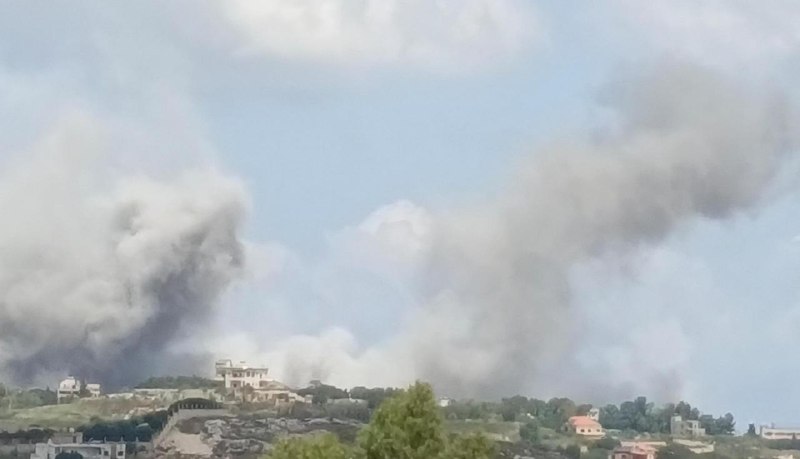
At 08:44 UTC on 14 June 2026, two alerts from The Cradle Media's Telegram channel reported Israeli airstrikes on the Al-Sharqiya area of Lebanon's Nabatieh governorate, the latest in a sequence of strikes that have run in parallel with an unusually public operational summary from Hezbollah describing its posture in the south of the country. The strikes landed in the same hour that the Iran-aligned movement's media operation was distributing, via the Palestine Chronicle, a long-form account of ambushes, rocket barrages and drone attacks it said had been directed at Israeli ground units attempting to penetrate the frontier zone.
The two threads are not the same event, but they sit inside the same afternoon and the same operational logic. Read together, they describe a conflict along the Blue Line in which both sides are speaking at volume in real time, and in which the Lebanese side has chosen, for the moment, to publish its tactical claims in unusually granular form.
What the afternoon's reporting actually says
The Cradle's two flash alerts, both timestamped 08:44 UTC, identify the target area as Al-Sharqiya within the Nabatieh governorate, the southern Lebanese district that has carried the bulk of cross-border fire since hostilities resumed in late 2023. The channel did not, in the alerts shared with Monexus, specify ordnance type, target type, or casualty figures; the framing was location-only.
Ten minutes earlier, at 08:34 UTC, the Palestine Chronicle's Telegram feed had carried a Hezbollah statement describing its fighters as having "confronted Israeli infiltration attempts in southern Lebanon, launching ambushes, rocket barrages and drone attacks." A hyperlink in the same Telegram post pointed to a longer Palestine Chronicle article carrying the headline "Kill Zone: Hezbollah Re…" — the rest of the slug was truncated in the Telegram preview, but the URL path on palestinechronicle.com ran to a story using the phrase "kill zone" to characterise the terrain Hezbollah says it has prepared south of the Litani.
The juxtaposition is straightforward: a Hezbollah media operation presenting the south of Lebanon as a prepared battlefield, followed within minutes by Israeli air activity over the same governorate. Neither claim is independently corroborated within the source set available to this publication. They are, however, the public record of how the two sides are choosing to narrate 14 June 2026 in real time.
The 'kill zone' framing — what Hezbollah is claiming, and what it is not
The phrase "kill zone" is not Hezbollah's standard lexicon. It has appeared in the past in coverage of prepared defensive belts in eastern Ukraine and in intermittent use by US military trainers referring to overlapping fields of fire, but its application to a Hezbollah-controlled border strip in south Lebanon is notable for the operational specificity it implies.
The Palestine Chronicle-linked Hezbollah statement describes ambushes, rocket barrages and drone attacks — three distinct engagement methods, each of which carries a different logistical signature. Ambushes imply dismounted or semi-mobile anti-personnel teams operating in prepared positions; rocket barrages imply salvo launches from concealed launchers, almost certainly of the type Hezbollah has replenished since the 2024 conflict; drone attacks imply a loitering or one-way attack capability of the kind the movement has spent two years expanding in both Lebanon and, by some accounts, in coordination with allied units further east.
The claim is, in other words, that Hezbollah is fighting a layered fight rather than a single-mode fight. That is the operational read-off from the language Hezbollah chose. The statement does not provide coordinates, unit identifications, casualty figures, or any time-stamped footage that Monexus can independently verify within the available source set. It is also not contradicted by the Israeli strike alert from The Cradle, which describes air activity but does not address any ground component.
What we verified and what we could not
This publication's reporting here rests on a small, well-defined source set: two flash alerts from The Cradle Media's Telegram channel, timestamped 08:44 UTC on 14 June 2026, identifying Israeli airstrikes on Al-Sharqiya in Nabatieh governorate; and one Telegram post from the Palestine Chronicle, timestamped 08:34 UTC the same day, carrying a Hezbollah statement on "infiltration attempts" in southern Lebanon alongside a link to a Palestine Chronicle article using the phrase "kill zone."
What Monexus can verify from those items:
- That at 08:44 UTC on 14 June 2026, The Cradle Media's Telegram feed reported Israeli airstrikes on Al-Sharqiya in Nabatieh governorate, south Lebanon.
- That at 08:34 UTC the same day, a Hezbollah statement was distributed via the Palestine Chronicle Telegram feed claiming confrontations with Israeli "infiltration attempts" in southern Lebanon via ambushes, rocket barrages and drone attacks.
- That the Palestine Chronicle article linked from that Telegram post frames the south Lebanon frontier in the language of a "kill zone."
What Monexus cannot verify from the available source set, and what readers should treat as unconfirmed:
- The exact ordnance used, the specific target, the number of strikes, or the resulting damage on the Israeli side of the afternoon's events in Nabatieh.
- Any Lebanese casualty figures. None of the source items provide them, and The Cradle's alert is location-only.
- The existence, identity, or losses of any Israeli ground unit operating inside Lebanese territory at the time of Hezbollah's statement. The phrase "infiltration attempts" is Hezbollah's own characterisation.
- Whether the Palestine Chronicle's "kill zone" framing originates in a Hezbollah press product, an editorial decision by the outlet, or a hybrid of the two. The article slug is truncated in the Telegram preview and the underlying piece was not directly read by this publication.
- The timing relationship between Hezbollah's claimed ground engagements and The Cradle's reported Israeli air activity. The Telegram timestamps place them within ten minutes of each other, but Telegram post times reflect distribution, not the underlying events themselves.
The honest ledger is short: the public record for 14 June 2026 in Nabatieh, within the sources available to Monexus, is a Hezbollah media product describing prepared ground defences and a location-only alert describing Israeli air activity over the same governorate, both posted within the same ten-minute window.
The counter-read — why the dominant framing may be overreading the data
A reasonable counter-read is that the apparent coherence of the two Telegram posts is a media artefact rather than a battlefield fact. Telegram channels, including The Cradle's, are heavily editor-curated; the Palestine Chronicle is sympathetic to the axis of which Hezbollah is a member. The two posts may reflect a single day's worth of routine, low-significance cross-border activity packaged for an audience that consumes the south Lebanon theatre as continuous action.
That counter-read is worth stating clearly. The Blue Line has seen almost daily low-level exchanges since late 2023. The Cradle's alerts are produced in volume. A single afternoon of one location-only strike alert and one Hezbollah statement does not, on its own, establish a meaningful tactical pattern; it establishes a normal day's news footprint.
What argues against that counter-read is the unusual specificity of the Hezbollah statement. "Kill zone" is not a phrase the movement has previously used in its English-language products, and the deliberate enumeration of ambushes, rocket barrages and drone attacks reads as a designed disclosure rather than a routine communiqué. The statement appears calibrated to convey, in advance, what an Israeli ground operation would encounter — which is itself a form of deterrent signalling, or a form of post-hoc justification, depending on what the underlying events turn out to have been.
Stakes — what 14 June tells us about the trajectory
If the Hezbollah framing is even approximately accurate, the implication for the south Lebanon theatre is that the movement intends to fight a sustained, multi-axis ground defence rather than a rocket-only campaign — the latter being the posture most analysts assumed in the immediate aftermath of the November 2024 ceasefire. Drone and anti-armor ambushes, layered on top of rocket fire, are a different proposition: they are designed to attrit ground units attempting to advance into prepared terrain, and they raise the political and military cost of any Israeli push into Lebanon proper.
If the framing is operational theatre of a more familiar kind, the implications are more modest. Routine low-level exchange, with the day's public narrative published in real time by both sides' preferred outlets, is the south Lebanon baseline. The two readings are not mutually exclusive; a single afternoon can carry both.
What is unambiguous is that the public information environment around the Blue Line has tightened. Both sides are publishing in near-real-time, both sides are curating their claims for a Telegram-first audience, and the gap between the public narrative and any ground truth is being managed — by both Israel and Hezbollah — at the level of language itself.
This article has been built from three Telegram items distributed on 14 June 2026, two from The Cradle Media and one from the Palestine Chronicle. Where the available sources do not specify a fact — including casualty figures, ordnance type, or the identity of any ground unit — this publication has said so rather than infer it. Where the available sources are themselves a media product of one of the parties to the conflict, that fact is named in the ledger above.
Wire provenance
This editorial synthesis draws on the following public wire/social posts:
- https://t.me/thecradlemedia
- https://t.me/TheCradleMedia
- https://t.me/PalestineChronicle
- https://t.me/thecradlemedia
- https://t.me/PalestineChronicle