McGinn's strike ends Scotland's 28-year World Cup wait as Haiti falls 1-0 in Boston
John McGinn's first-half goal in Boston delivered Scotland's first World Cup finals goal in 28 years and a 1-0 win over Haiti, putting Steve Clarke's side in control of Group C.
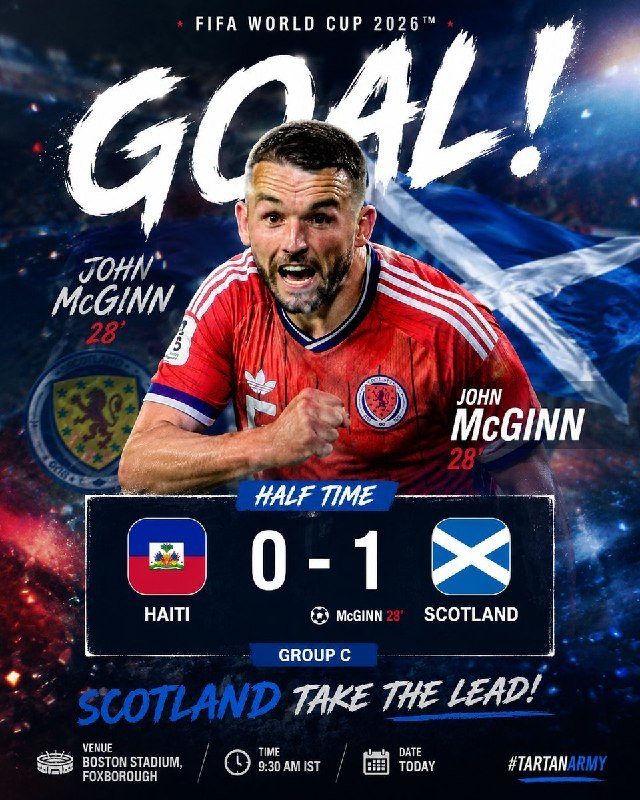
BOSTON — At 01:38 UTC on 14 June 2026, John McGinn ended a national hoodoo. The Aston Villa midfielder's first-half finish gave Scotland a 1-0 win over Haiti at the World Cup 2026 Group C opener in Boston, and with it the country's first World Cup finals goal in 28 years, as confirmed by FIFA's official account and amplified by The Athletic. By 02:38 UTC McGinn had nearly doubled the lead, drifting a low effort just wide of the right post, and by 03:13 UTC the final whistle had confirmed three points for Steve Clarke's side and a statement of intent in a group many had tipped them to navigate on grit rather than craft.
A single goal decided the contest, but the framing matters as much as the scoreline. Scotland's qualifying campaigns since 1998 have been a long study in near-misses — the play-off penalties, the away-goal heartbreaks, the late collapses. McGinn's strike does not erase that ledger, but it does reset it. For a nation that has waited two and a half decades to find the net on this stage, the relief inside the Tartan Army end at Boston's stadium was audible even through the federation's clipped social copy.
The goal that broke a generation of silence
The 28-year stat, repeated by FIFA's verified channel moments after the ball hit the net, is the headline number because it has to be. Scotland's last World Cup finals appearance, France 1998, ended in a group-stage exit and a single goal scored by Kevin Gallacher against Morocco. Since then there have been three major-tournament qualifications — Euro 2020 and Euro 2024 — but no World Cup minutes, and certainly no World Cup goals, until McGinn's finish on the artificial surface in Massachusetts. The Athletic carried the same line in its post, signalling that the figure is now part of the official tournament record.
The venue matters. Boston is one of the three US host cities the 2026 tournament shares with Mexico and Canada, and the Group C schedule is constructed to give the European qualifiers a soft landing. Clarke's squad, the oldest average age at the tournament, was always going to be judged on whether its experience could manufacture goals against a Haiti side making its first World Cup appearance since 1974. The single-goal margin does not settle that question, but it postpones it.
The counter-read: scoreline flatters the form book
A one-goal win against a Haiti side ranked outside the top 80 is, on paper, the minimum acceptable return. McGinn's near-miss in the minutes before half-time, picked up by teleSUR's English feed at 02:38 UTC, is a useful reminder that Scotland did not control the contest as comfortably as the result suggests. Haiti arrived in Boston with a low-block identity and a willingness to break at speed; for long stretches of the opening 45 they absorbed pressure without conceding a second, and the second half offered Clarke little to settle the nerves.
There is a competing framing worth holding onto: that tournament openers are almost always tight, and that Scotland's job was to bank three points and move on. The dominant wire line — that McGinn's goal is a cathartic national moment — is not wrong, but it is incomplete. The harder test is the next fixture, when a more clinical opponent will punish the profligacy McGinn himself exhibited with that dragged shot wide of the post.
A small goal in a tournament of structural stakes
World Cup 2026 is the first edition expanded to 48 teams, and the structural read on a Scotland win is bigger than the 90 minutes in Boston. The expansion, driven by FIFA president Gianni Infantino, is explicitly designed to deepen the talent pool in non-traditional markets — including Caribbean football, where Haiti's presence in Group C is itself a product of the new format. A 1-0 result that hands the experienced European side three points while validating the federation's decision to invite a smaller-nation contender to the dance is, in that sense, exactly the script FIFA's communications team wanted to write.
The counter-view, articulated quietly across Caribbean and Central American federations since the 2026 host vote, is that expansion dilutes competitive intensity at the top of the group while extracting broadcast value from minnow-vs-minnow fixtures elsewhere in the draw. Scotland's narrow win over Haiti is the cleanest possible case study: a legacy side banked its goal, a debutant side went home with the respectability of a one-goal loss, and the broadcaster moved on to the next match window.
What Scotland takes to the next game
Three points and a clean sheet. A goalscorer whose name will be on the back pages in Glasgow for the first time in a generation. And the small, uncomfortable knowledge that one McGinn moment, however historic, is not a tournament plan. Clarke's side will need to convert territory into chances against the more technical opponents further down the group, and the Boston near-miss suggests the supply lines into the box remain a work in progress. Haiti, for its part, exits the opener without points but with a performance that should hold the dressing room together for the fixtures ahead.
The remaining uncertainty is routine tournament uncertainty: rotation, fatigue, the second-game syndrome that historically flattens opening winners. Scotland have, for the first time in 28 years, the right to worry about those problems from the top of the table.
How Monexus framed this vs the wire: official social posts from FIFA and The Athletic set the celebratory 28-year frame; Monexus adds the structural read on the 48-team format and the tactical caveat that the scoreline flattered Clarke's side.
Wire provenance
This editorial synthesis draws on the following public wire/social posts:
- https://t.me/FIFAcom
- https://t.me/TheAthletic
- https://t.me/FIFAcom
- https://t.me/TheAthletic
- https://t.me/GeoPWatch