Ukrainian drones hit Rybinsk ammunition plant deep inside Russia, exposing depth-of-strike limits
An overnight strike on the Temp combine in Yaroslavl region set fires and rained oil on the city, a reminder that Ukraine's reach is lengthening even as the question of what it can sustainably hit grows more pointed.
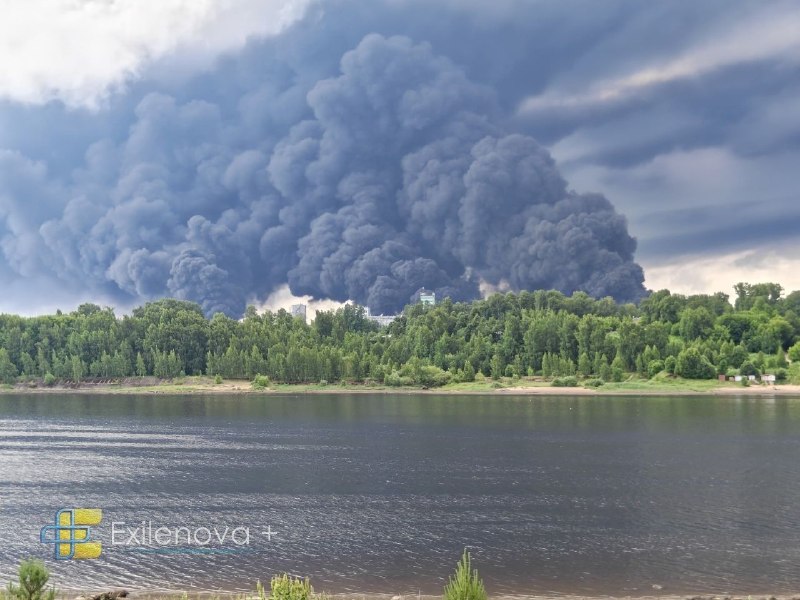
Overnight strikes on the city of Rybinsk, in Russia's Yaroslavl region, lit up a facility that produces ammunition and explosives for the Russian military, setting fires that showered the surrounding area in a film of oily residue. Ukrainian-affiliated channels circulated video of the moment one of the drones hit the Temp combine, roughly 300 kilometres northeast of Moscow and well outside the range of anything Kyiv could reach with the artillery of two years ago. By 07:43 UTC on 14 June 2026, the Ukrainian journalist Andriy Tsaplienko was reporting what he called "oil rain" over the city — a colloquial shorthand for the fallout of fuel and feedstock ignited at the plant.
The strike matters less for the damage it will inflict on a single combine than for what it says about the geometry of the war. Ukraine is now systematically putting Russian cities in the European heartland within reach of a weapons class that, at the start of the full-scale invasion, was confined to the borderlands. The Temp combine sits more than 700 kilometres from the nearest stretch of Ukrainian-controlled territory. The fact that it is on fire is itself the story.
What was hit, and what is known
The target is the Temp combine in Rybinsk, a city of roughly 180,000 on the upper Volga. According to a summary posted by the open-source channel WarTranslated and amplified by the OSINT aggregator @osintlive on 14 June 2026, the facility produces ammunition and explosives for the Russian armed forces. The moment of impact — at least one of the drones striking the main production buildings — was caught on dashcam and rooftop footage that spread across Ukrainian Telegram channels within hours.
Russian regional officials acknowledged fires in the area but stopped short, in the immediate aftermath, of confirming the precise extent of damage to the plant itself. The Ukrainian outlet TSN, summarising Russian-language analyst commentary on the morning of 14 June, framed the strike inside a broader argument: that Russia is "losing its main advantage in the war," defined in the piece as the capacity to absorb blows against its interior while continuing to project firepower on the line of contact. That is a claim, not a finding, and it depends on strikes like Rybinsk being repeated at a tempo that meaningfully degrades Russian defence-industrial output rather than merely punctuating it.
The "oil rain" descriptor, drawn from Tsaplienko's morning post, points to secondary effects: combustion of fuel oils, lubricants and possibly raw explosive precursors at a site that by definition stores them in volume. Local Russian emergency-services reporting cited in the same Telegram thread said residential buildings were not damaged in the initial wave, but the air-quality and contamination footprint of a strike on a chemical-industrial site is rarely confined to its fence line.
The counter-narrative, and what it concedes
The Russian framing, as carried by state-aligned outlets and milbloggers in similar incidents, is twofold. First, that Ukraine is using long-range strike capability not against military targets but against civilian infrastructure — an attempt to shift the optics of the war by importing the language of "terrorist" attacks into Russian domestic coverage. Second, that the strikes are tactically insignificant: a few dozen drones against a country the size of Russia, intercepted or shrugged off, useful only as propaganda.
The first line does not fit Rybinsk. WarTranslated and the OSINT community identified the target by name as a defence-industrial facility; the imagery is consistent with that identification. The second line is more serious and harder to dismiss. A single drone strike on a single plant, in a country with hundreds of munitions and explosives facilities, does not by itself rewrite the material balance of the war. Russian output of artillery shells, glide bombs and tank rounds has grown, not shrunk, since 2024, in part because the country has reorganised its defence-industrial base around dispersed, often improvised production lines. The Temp combine, if it is back online in days or weeks, becomes a morale story and a video rather than a strategic one.
What the strike does establish is reach. In the first year of the full-scale invasion, Ukrainian strikes inside Russia were almost entirely confined to Belgorod, Bryansk and Kursk oblasts, the regions that border Ukraine. By 2025, attacks on refinery and logistics sites in Tatarstan and the Krasnodar region had become regular. Rybinsk is further north and further east than most of those targets — closer in geography to Vologda and the industrial Volga than to the traditional Ukrainian strike corridor. The geography of the war, in other words, is being redrawn in the air as well as on the ground.
The structural frame
The deeper story is not the drones. It is the supply chain behind them. Ukrainian long-range strike capacity, measured in monthly production of attack UAVs and the gradual introduction of indigenous cruise-missile programmes, has shifted from a niche capability fielded by a small number of units to an output of an industrial system. The bottleneck has moved from design to throughput, and from there to target intelligence. The Temp strike, on the evidence available, was the product of a confirmed target nomination, a route that minimised exposure to Russian air defence, and a payload appropriate to the building type. Each of those is now a routine rather than a feat.
Two structural limits remain. The first is volume. Russia fields more drones, more glide bombs, more artillery shells in a month than Ukraine can hope to match in a year, and the industrial-policy gap is being closed only slowly by European assistance and Ukrainian domestic production. Strikes on Russian defence plants, however dramatic, do not close that gap from the other side on a one-for-one basis. The second is escalation management. Attacks on facilities in the European Russian interior raise, with each cycle, questions about how Moscow chooses to respond — whether through strikes on Ukrainian defence-industrial nodes, through hybrid action against supporting European states, or through a more direct confrontation with NATO airspace. None of those responses is foreordained; all of them become more available as the strike set lengthens.
There is also a question of what the strikes are for. If the purpose is to degrade Russian munitions output materially, the answer must be volume, redundancy and persistence — the same doctrine Russia has applied against Ukrainian energy infrastructure. If the purpose is to shape Russian elite and public opinion, the calculus is different and the relevant metric is coverage, not tonnage. Ukrainian communications around Rybinsk, including the rapid circulation of impact footage and the framing of "oil rain," suggests the latter is at least part of the intended effect.
What we do not yet know
A handful of things remain genuinely uncertain in the reporting available on 14 June 2026. The full extent of damage to the Temp combine — whether production lines are destroyed, damaged but repairable, or merely disrupted — is not yet visible in open-source imagery. Russian authorities' casualty figures for plant workers, if any are released, are not yet on the wire. The number of drones involved in the attack, the specific munition type, and the route taken are not yet confirmed by independent observers. WarTranslated and @osintlive are credible aggregators but are not, on a strike like this, a substitute for satellite-based battle-damage assessment, which takes days rather than hours.
There is also a more fundamental evidentiary gap. Ukrainian sources have every reason to emphasise the strike's success; Russian sources have every reason to minimise it. The honest reading, on the morning after, is that a named Russian defence-industrial facility was struck by loitering munitions, that fires broke out, and that the event has been documented on video. The strategic effect of that strike is genuinely contested, and the answer will not be clear for weeks. The point worth holding onto is the one that is not in dispute: that the war is now being fought at distances, and against categories of target, that looked implausible when the invasion began.
Desk note: Monexus has framed the strike against the Temp combine through the lens of reach, not tactical damage assessment — a deliberate choice given the limited independent verification available on the morning of 14 June 2026. Wire reporting on Russian strikes has tended to emphasise either Ukrainian derring-do or Russian resilience; we have tried to leave space for the more uncomfortable fact that both are true, and that the war's industrial arithmetic does not move on a single overnight strike, however dramatic the footage.
Wire provenance
This editorial synthesis draws on the following public wire/social posts:
- https://t.me/Tsaplienko/
- https://t.me/TSN_ua
- https://t.me/wartranslated
- https://t.me/wartranslated
- https://t.me/s/osintlive
- https://twitter.com/wartranslated/status/20660457684