Ukrainian drones hit Russia's Azot chemical plant in Tula region, extending strikes on industrial depth
Overnight strikes on the Azot fertiliser complex in Novomoskovsk mark a continued push at Russian chemical-industry sites well behind the front line, with local accounts of multiple impacts at a major ammonium-nitrate producer.
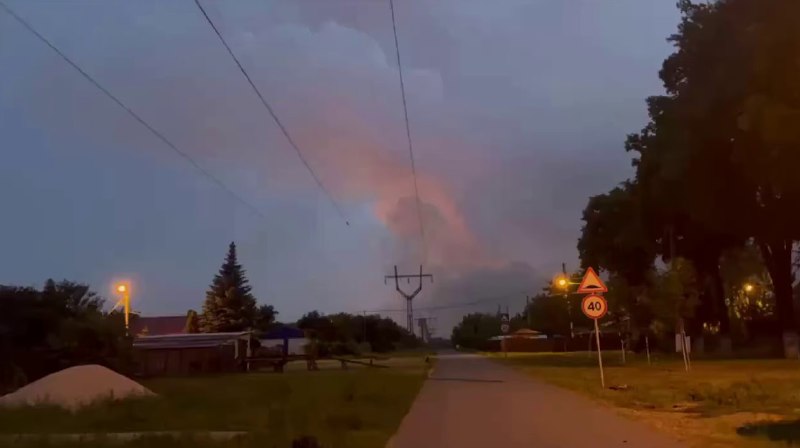
Drones struck the Azot chemical plant in Novomoskovsk, in Russia's Tula region, overnight on 13–14 June 2026, with local residents reporting multiple impacts at a facility that produces ammonium nitrate and ranks among Russia's larger nitrogen-fertiliser sites, according to the Telegram channel Noel Reports. The attack was corroborated by the open-source account WarTranslated and by OSINTLive, both of which logged the strike in the early hours of 14 June and pointed to local video circulating on social media. No casualty figures from the plant or surrounding residential areas had been published by 06:39 UTC, and Russian federal authorities had not, as of that timestamp, issued a confirmed statement on the damage envelope.
The strike is the latest in a sequence of Ukrainian long-range drone attacks aimed at Russian chemical, refining and explosives-industry infrastructure sited hundreds of kilometres from the front line. Novomoskovsk lies roughly 300 kilometres south of Moscow, inside Russia's industrial heartland. The pattern matters: as kinetic exchanges at the contact line have settled into a grinding attritional rhythm, the centre of gravity of the air war has shifted toward production assets whose loss degrades Russia's ability to sustain ammunition output and the agricultural inputs on which its domestic food system depends.
What is known about the strike
The available reporting converges on a narrow set of facts. Noel Reports said the Azot plant in Novomoskovsk was hit overnight and that local residents reported multiple impacts, identifying the facility as a producer of ammonium nitrate and one of Russia's major producers of the compound. WarTranslated, a widely-followed translation account that aggregates Ukrainian and Russian-language frontline reporting, logged the same incident shortly after 06:39 UTC, reposting footage and linking to a video tweet that showed the aftermath of the strike. OSINTLive independently confirmed the location and timing. The three accounts — a frontline channel, a translation feed, and a multi-source OSINT aggregator — drew on overlapping material rather than a single official readout, which is typical at this stage of an overnight strike before Russian emergency services brief.
What the sources do not specify is the weapons system used, the precise number of impacts, the scale of damage to the ammonium-nitrate production lines, or whether any detonation of stored material occurred. Azot-class plants are hazardous precisely because the feedstock is itself an oxidiser and, in concentrated form, an explosive. Independent verification of production-line status typically takes 24 to 72 hours, often via satellite-imagery analysis and Russian regional officials' statements on evacuation perimeters.
Why a fertiliser plant is a wartime target
Ammonium nitrate sits at the intersection of three Russian strategic vulnerabilities: ammunition, agriculture, and export revenue. The compound is a primary oxidiser in industrial explosives and in the bulk slurry charges used in mining and in certain categories of artillery and rocket propellant. Civilian use is concentrated in fertiliser blends for spring and autumn application across Russian grain belts, where domestic supply tightness quickly transmits into price pressure on bread and pasta. Ammonium nitrate is also a major Russian export product to BRICS and Global South buyers, generating hard currency at a time when the federal budget is straining under war costs and oil-revenue volatility.
Attacks on chemical-industry nodes are not new. Ukrainian strikes on Russian refineries, ammonia terminals, and explosives plants have intensified through 2025 and into 2026, with the explicit aim of compressing Russia's domestic fuel supply, narrowing the fiscal base, and forcing redeployment of air-defence assets away from the front. Azot in Novomoskovsk is a useful test case because its product line has both military and civilian end-uses, which complicates Moscow's framing of such strikes as terrorism against civilian industry. Russian official messaging has consistently characterised Ukrainian strikes on energy and chemical infrastructure as attacks on civilian targets; Ukrainian messaging, by contrast, has framed the same sites as dual-use assets that materially sustain the war effort.
The counter-narrative: how Moscow frames the strike
Russian state-aligned channels have, in similar incidents, framed overnight drone strikes on chemical and refining infrastructure as terrorist acts against the civilian population, emphasising proximity to residential areas, the risk of toxic releases, and the alleged use of Western-supplied targeting data. TASS and RIA Novosti typically lead with emergency-services activity and downplay military-economic effects, while Russian milblogger channels debate air-defence performance and attribute the strikes to NATO-enabled intelligence support rather than to indigenous Ukrainian drone production. The pattern is consistent enough to be predictable: the strike is acknowledged, damage is minimised, and political responsibility is shifted to Ukraine's external backers.
The strongest version of that argument holds that striking chemical plants endangers surrounding populations and that any military benefit is outweighed by the humanitarian cost. The strongest counter-argument is that Russian dual-use industry is a legitimate military objective under the law of armed conflict, and that the operational effect of degrading a major ammonium-nitrate producer is felt first in the Kremlin's ammunition budgets rather than on grocery shelves. Both framings carry evidence; neither is self-refuting. The honest reading is that strikes of this kind inflict real civilian-side risk while degrading the material base of the invasion, and the policy debate in Kyiv and among Ukraine's partners is over how to weigh those two effects, not over whether one of them is real.
Structural frame: industrial depth as a war variable
What the Novomoskovsk strike illustrates, more clearly than any single incident, is that the war has become a contest over industrial depth — the capacity of each side to replace the materiel consumed in combat. For Ukraine, the constraint is access to long-range strike systems, interceptor drones, and air-defence interceptors. For Russia, the constraint is the physical survival of the production nodes that feed its artillery, drone, and propellant supply chains. The two constraints are not symmetric: Ukraine can lose strikes without losing the war, while Russia can absorb strikes on individual facilities but cannot indefinitely lose the cumulative output of its chemical, refining, and machine-building base. Each successful penetration of Russian airspace at this depth is, in effect, a small down-payment on a Russian rearmament bill.
The pattern also reveals something about the geometry of escalation. Russian strikes on Ukrainian energy infrastructure in 2022 and 2024 followed a similar logic: degrade the underlying capacity of the opposing society to sustain war, and accept the civilian cost as the price. Ukrainian strikes on Russian chemical and refining capacity are the mirrored response, conducted with smaller weapons and at longer ranges, and therefore more dependent on intelligence, on drone production, and on the political will of partner governments to allow the use of donated systems against targets deep inside Russia. The debate in Western capitals over those permissions is, in practice, the strategic debate of the war.
Stakes and what to watch next
The immediate stakes are local. Residents of Novomoskovsk will be watching for confirmation of toxic releases, evacuation orders, and casualty figures, and the Tula regional administration will face pressure to disclose production-line status at a site that is one of the largest employers in the city. The federal stakes are industrial: every day that an ammonium-nitrate line is offline is a day that Russia's domestic fertiliser allocation and its export shipments to BRICS buyers are reduced, and the cumulative effect across the spring application window is a measurable fiscal and political cost. The strategic stakes are escalatory: the more frequently Ukrainian drones reach targets at this depth, the louder the Russian argument becomes for strikes on Ukrainian government and industrial sites in response, and the harder it becomes for partner governments to keep the rule of use narrow.
What remains uncertain, and where the evidence thins, is the operational impact. Independent observers have not yet published imagery analysis of the Novomoskovsk site, and Russian official statements on production status typically lag tactical reality by days. Watch for two data points: the Tula governor's read-out on casualties and evacuation, and satellite-imagery assessments of the ammonia and nitric-acid units over the next 72 hours. Either will tell us whether this was a symbolic strike or a genuine hit on a productive asset.
Desk note: Wire reporting on the strike is limited to Telegram-channel accounts and the embedded social-media post. Monexus treats Noel Reports, WarTranslated and OSINTLive as open-source leads at this stage and will update with confirmed figures as official Russian and independent imagery-based assessments become available.
Wire provenance
This editorial synthesis draws on the following public wire/social posts:
- https://t.me/noel_reports
- https://twitter.com/wartranslated/status/2066047791269355726
- https://t.me/wartranslated
- https://t.me/osintlive
- https://t.me/noel_reports/2066047791269355726