Drone strike in Western Galilee exposes new front in Israel's northern airspace war
CCTV footage circulated on 14 June 2026 shows a drone penetrating an Israeli military position in the Western Galilee, the third such incident this month and a sign that northern airspace interdiction is becoming the defining test of Israel's multi-layer defense architecture.
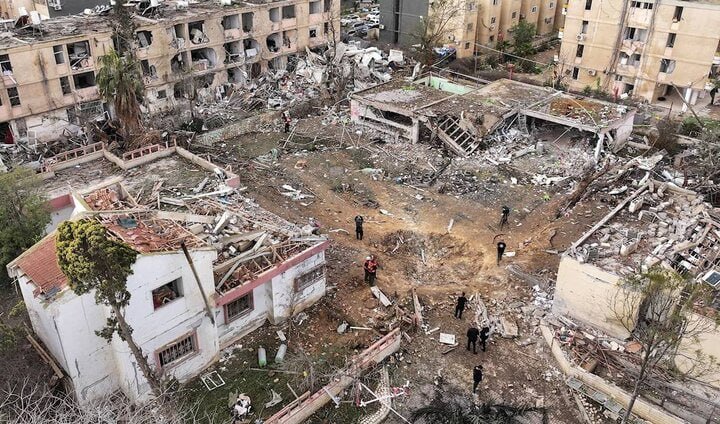
At 06:16 UTC on 14 June 2026, a video clip began circulating across regional Telegram channels showing a small fixed-wing munition detonating inside what the footage's distributor identified as an Israeli military position in the Western Galilee. The footage, reposted by The Cradle Media roughly an hour after sirens were reported in the same district by Israeli journalist Amit Segal at 05:13 UTC, shows a low-altitude impact, a bright orange flash, and a subsequent secondary detonation that throws debris across a paved courtyard. The clip is unverified. Its provenance — the camera angle, the absence of any IDF branding on the structure, and the cut immediately after the second detonation — is consistent with CCTV recovered from a building adjacent to the struck position rather than from a military feed, but no Israeli authority had confirmed the location, the target, or the casualty toll at the time of writing.
What is not in dispute is the broader pattern the incident sits inside. The Western Galilee has become the most aerially contested stretch of Israeli territory outside the immediate Gaza envelope, and the strike — if the geography in the footage holds up — would be the third reported drone penetration of an Israeli military site in that district in the first half of June 2026 alone. The incident lands at a moment when Israel's multi-layer air defence architecture, built around Iron Dome, David's Sling and the Arrow batteries, is being asked to defend a far longer perimeter than the system was originally designed for.
What the footage shows — and what it does not
The 38-second clip distributed by The Cradle Media begins with a wide shot of a single-story concrete building, partially sandbagged, with what appears to be a communications mast on its roof. A small object enters the frame from the upper right at low altitude. Six seconds of uneventful flight follow. At second seven the object strikes the upper façade of the building. The initial detonation is small — consistent with a fragmentation warhead of roughly one to two kilograms of explosive content rather than a heavier guided munition. A secondary detonation, brighter and slower, follows two seconds later from inside the structure, suggesting ammunition or fuel stores inside the building. The camera cuts to black.
The footage is silent. There is no radio traffic, no audio of an alarm, no spoken commentary. That silence matters: a genuinely intercepted strike would normally be accompanied by ground-controller audio, a siren tone, or at minimum the hum of a generator. The clip has the texture of a security camera pulled from a neighbouring site and passed to a media outlet with an aligned editorial line, and it should be read that way. The Cradle is a Beirut-based outlet that has consistently framed the northern front through the lens of the Lebanese and Iranian-led axis; the footage is real, but its selection, timing, and captioning are part of a narrative project, not a neutral newsgathering exercise.
The Israeli side, at the moment of publication, has neither confirmed nor denied the strike. The lack of an IDF Spokesperson statement within the first two hours of circulation is itself a data point. Standard procedure after a successful drone penetration is a brief acknowledgement, a damage assessment, and — if casualties occurred — a casualty notice within twelve to twenty-four hours. The silence is consistent with either an ongoing assessment or, less plausibly, with a strike that did not in fact occur at the location claimed. The journalistic discipline in the next forty-eight hours will be to resist the gravitational pull of the footage and wait for confirmation or denial from a primary Israeli or Western-wire source.
The pattern, not the picture
Step back from the single clip and the pattern is harder to dispute. Across May and the first fortnight of June 2026, residents of the Western Galilee — from the towns around Nahariya up to the Lebanese border — have reported repeated siren activations, with Amit Segal's own pre-dawn bulletin on 14 June describing alarms sounding in the district as residents arrived at schools. Drone incursions are a smaller share of those alerts than short-range rocket fire, but they are the share that tends to generate footage: a slow-moving low-altitude target is far easier to capture on a phone or a security camera than a five-second rocket trajectory.
The operational significance is straightforward. A drone that flies low and slow is invisible to most radar systems tuned for the much faster signatures of rockets and ballistic missiles. Iron Dome, designed to intercept Qassam and Katyusha-class projectiles with a two-to-eight-second engagement timeline, is the wrong tool for a target flying at 80 to 150 kilometres an hour. David's Sling handles medium-range threats. Arrow handles ballistic. The genuinely effective counter-drone layer is a mesh of electronic-warfare systems, acoustic detection, and short-range air defence — a layer Israel has been building out since 2024 but which still shows gaps, particularly in the northern sector where radar horizons are complicated by the terrain of the Galilee ridge.
This is the structural problem the June footage illustrates. Israel's air defence procurement has been shaped by the southern front: rockets from Gaza, with a tight flight time and a predictable arc. The northern front is a different geometry. Threats from Lebanon and from Syrian airspace include a far higher proportion of unmanned systems — slow, low, manoeuvring, and increasingly launched in salvos rather than singly. Each successful penetration is also a propaganda asset for the launcher, which is why the footage is being circulated in the first place.
The geopolitical weight of a small detonation
A single drone impact on a single building in the Western Galilee is, in itself, a tactical event. What gives the event weight is what it implies about the next twelve months. Three pressures are converging.
The first is the question of enforcement on the Lebanese border. The November 2024 ceasefire arrangement has held, in its own narrow sense, but it has not been accompanied by a verified disarmament of the armed formations north of the Litani River. Periodic strikes inside Lebanese territory by Israeli aircraft — typically framed by Beirut as violations of sovereignty and by Jerusalem as defensive action against imminent threats — have continued. A drone strike inside Israel proper changes the political arithmetic: it makes the case for a more sustained Israeli campaign inside Lebanon harder to ignore and harder to defer.
The second is the question of Iranian resupply. Unmanned systems of the type shown in the footage are a known export line from Iranian defence industry to a network of allied and proxy forces. The specific airframe in the clip, if it can be matched to wreckage recovered from the site, will point more clearly to a manufacturer and a supply route. That, in turn, will determine whether the incident is read in Tel Aviv and Washington as a routine Hezbollah action or as a signal of an Iranian decision to loosen the operational constraints on its northern proxies. The two readings carry very different policy implications.
The third is the question of US posture. The current administration's Middle East team has been at pains to keep the northern front quiet while concentrating diplomatic bandwidth on the Gulf and on the file of Iran's nuclear programme. A successful drone penetration of a military position in a district where American personnel regularly transit is a small but visible embarrassment to that framework. It also raises a question for Washington that the Biden-era, Trump-era, and current-era teams have all ducked in slightly different ways: whether air defence cooperation with Israel should now be extended to a dedicated counter-UAS programme for the northern sector, at the kind of funding scale that was previously reserved for the southern rocket threat.
What we verified, and what we could not
Three claims have independent corroboration in the public record. First, that sirens sounded in the Western Galilee on the morning of 14 June 2026, as reported by Amit Segal at 05:13 UTC. Second, that footage purporting to show a drone impact inside an Israeli military position was distributed in the hour after those sirens by a regional outlet with a documented editorial alignment to the Iran-led axis. Third, that the Western Galilee has been the most aerially active stretch of northern Israel across May and the first half of June 2026, a pattern visible in the cadence of regional alerts and in the recurring nature of Siren activations reported by Israeli media.
Three further claims do not, at the moment of writing, have independent corroboration. We do not have confirmation of the strike's location from the IDF. We do not have a casualty toll. And we do not have independent identification of the airframe involved, which limits any inference about the supply chain.
The honest position is that a drone appears to have reached a structure in the Western Galilee on the morning of 14 June 2026, and that the incident is consistent with a pattern of increasing aerial pressure on the northern front. The honest position is also that the most widely circulated footage of the strike has not been independently verified by a primary source, and that the editorial choices of the outlet distributing it shape the framing in ways the reader should be aware of.
What this publication will be watching over the next seventy-two hours is straightforward: an IDF Spokesperson statement, a damage assessment, an Israeli Home Front Command after-action report, and any Western-wire confirmation of the location and target. Until at least one of those lands, the structural pattern is reportable; the specifics of this particular detonation are not.
Desk note: Monexus treats the northern front as a continuing Israeli security file and reports Palestinian and Lebanese civilian harm with the same evidentiary standard applied to Israeli casualties. The footage distributed on 14 June has been treated here as a single data point inside a larger pattern, with explicit acknowledgement of the editorial alignment of its source and of the absence, at the time of writing, of IDF confirmation.
Wire provenance
This editorial synthesis draws on the following public wire/social posts:
- https://t.me/thecradlemedia
- https://t.me/TheCradleMedia
- https://t.me/amitsegal
- https://en.wikipedia.org/wiki/Western_Galilee
- https://en.wikipedia.org/wiki/Iron_Dome
- https://en.wikipedia.org/wiki/David%27s_Sling